
Published for US‑based independent website bag sellers, OEM / ODM importers and e‑commerce merchants
When you source custom bags directly from Chinese manufacturers for your US‑based bag website, fabric specifications make or break your final product quality, retail positioning, landed cost, and customer satisfaction. Many first‑time US buyers run into costly misunderstandings: they only state a vague product name such as “polyester backpack” in RFQs, without clarifying denier rating or PU coating thickness. Factories then substitute lower‑cost, lighter‑duty materials that visually look comparable yet under‑perform in real‑world use. This creates product returns, negative reviews and erodes trust on your independent store.
For American bag importers, it is critical to fully grasp how Chinese bag factories interpret **denier for woven fabrics** and **PU coating thickness**. These two metrics are primary quoting specifications, not secondary nice‑to‑have details. This blog breaks down core industry knowledge: which specs Chinese OEM and ODM suppliers commonly offer, real‑world FOB price premiums for material upgrades, shipping weight and dimensional‑weight consequences, and feasibility of custom fabric specs for low‑MOQ trial orders.
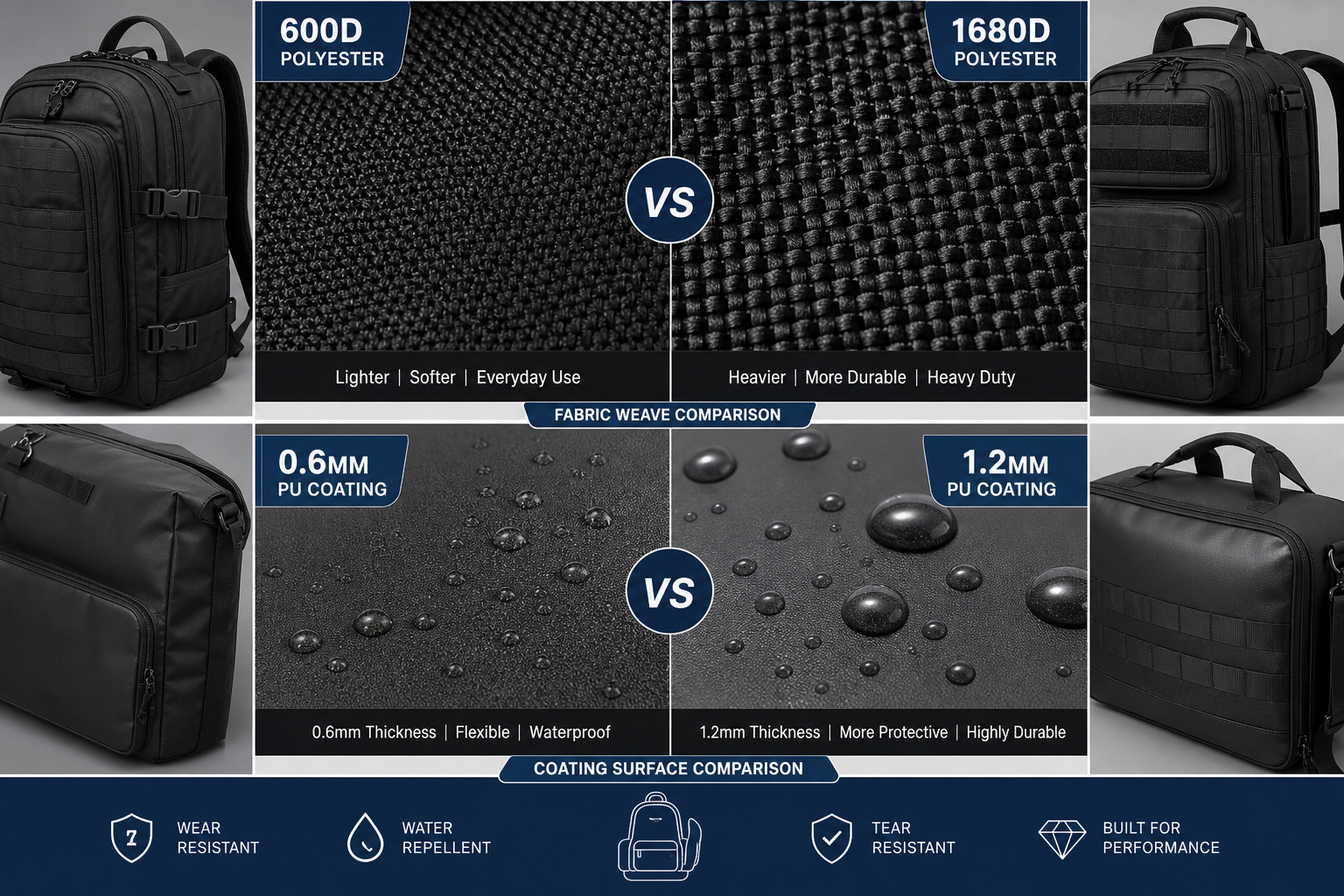
Are Denier and PU‑Coating Thickness Primary Specifications for Chinese Bag Factories?
A frequent question from US independent‑site bag buyers is whether Chinese bag manufacturers treat denier or coating thickness as core specification during quotation and production. The clear industry answer is yes. Both denier (D rating for polyester and nylon yarn) and PU / PVC coating thickness measured in millimeters serve as primary technical specs on factory specification sheets. They directly govern fabric durability, hand‑feel, water‑repellent performance, raw‑material expenditure, sewing complexity, finished‑item weight, and final FOB price.
Denier defines yarn linear density: technically, denier equals the weight in grams for 9 000 meters of a single yarn filament. Higher denier numbers correspond to thicker, heavier, more abrasion‑resistant yarn. In Chinese bag manufacturing, denier values are the go‑to benchmark to communicate fabric strength for backpacks, duffle bags, tool bags, tactical gear and luggage.
PU coating thickness, meanwhile, controls surface stiffness, waterproof performance, scratch resistance and material service life. Thicker PU layers deliver enhanced water resistance and longer wear cycles. Factories cross‑reference denier data with **GSM (grams per square meter)** readings. GSM describes overall fabric areal density, especially helpful for uncoated woven textiles. Suppliers routinely list denier, fabric composition, coating thickness and GSM together on formal spec sheets for OEM and ODM projects. You will rarely receive a formal quotation from a qualified Chinese bag factory without requesting these figures explicitly.
Many experienced Chinese bag producers deploy hybrid‑spec construction to balance cost and durability. A common practical solution is building bag bodies with mid‑grade 600D or 900D polyester, while reinforcing high‑stress bottom panels and shoulder‑strap attachment zones using heavy‑weight 1680D fabric. This design avoids upgrading every panel to expensive high‑denier material while preserving critical wear‑point performance for end‑users.
For reference on fabric‑grade segmentation: lightweight lining fabrics and minimalist daypacks rely on low denier material from 210D to 300D. Entry‑level school backpacks and promotional give‑away bags heavily adopt 600D polyester. Heavy‑duty tactical packs, motorbike luggage and premium travel bags move toward 1000D and above. Traditional ballistic nylon (1050D grade) is widely used within high‑end bag lines; Chinese textile mills have developed cost‑competitive 1680D polyester alternatives to replicate ballistic‑grade robustness at lower landed cost for US importers.
When you send RFQs to overseas suppliers, never specify only “polyester bag”. You must write both denier rating plus coating thickness. An example of complete specification language: *600D polyester Oxford fabric, 0.6 mm PU coating, target fabric weight 220 GSM*. Omitting coating millimeter metrics opens risk of factory substitution to thin 0.3 mm PU coating that delivers poor water resistance and rapid surface peeling under daily consumer use.
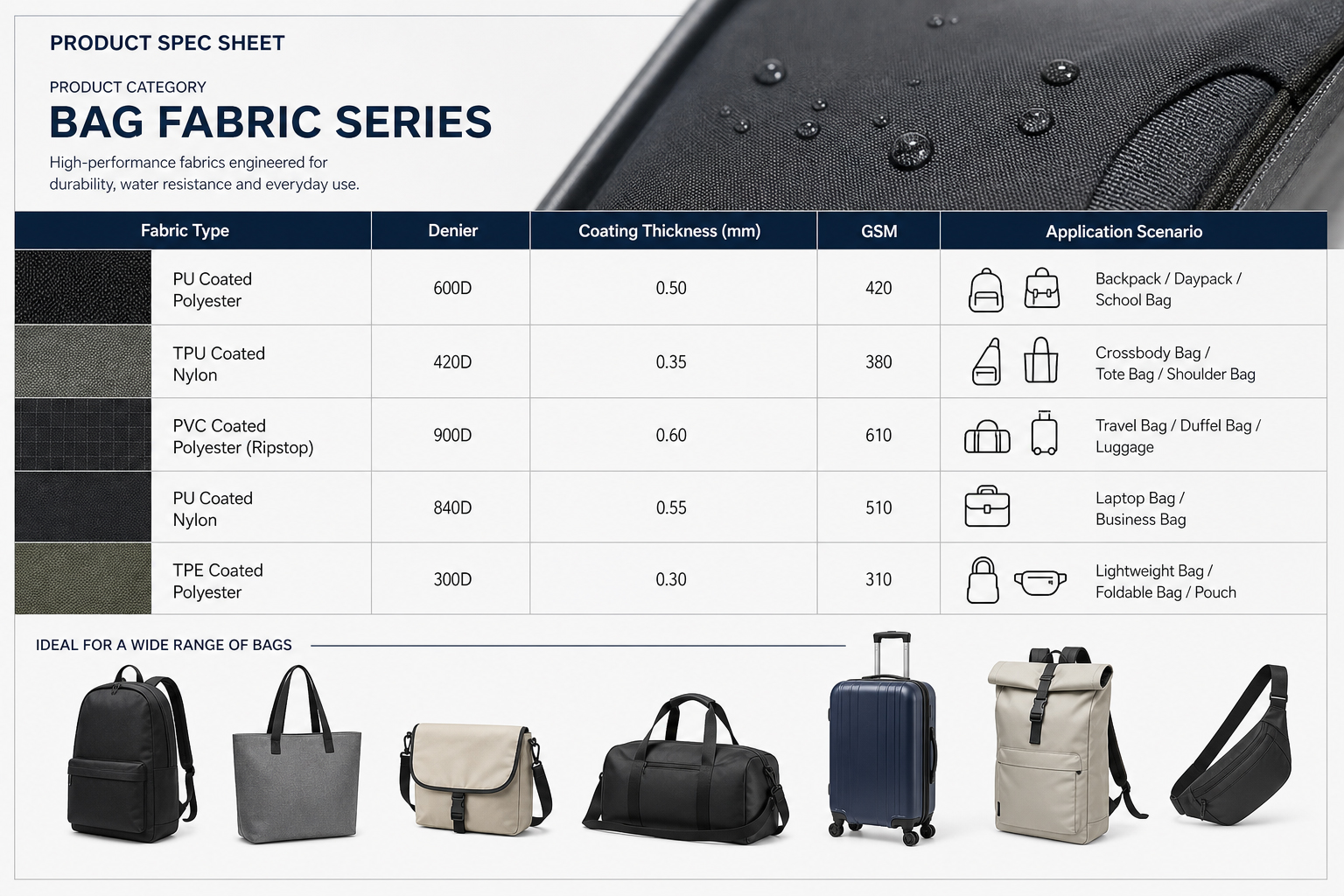
Standard Denier and PU‑Thickness Options for Chinese OEM / ODM Bag Orders
Chinese textile suppliers maintain well‑established standard fabric libraries for mass‑production OEM and ODM bag work. As a US independent‑store seller, understanding these standard options helps you set realistic product positioning and avoid asking for non‑stock fabric that triggers extremely high MOQ.
Polyester Oxford fabric represents the highest‑volume textile for export‑oriented bag factories. Its standard denier lineup includes 210D, 300D, 420D, 600D, 900D, 1200D and 1680D. Coating offerings fall into two major families: PU coating ranges from 0.3 mm up to 0.8 mm; PVC backing spans 0.4 mm to 1.2 mm and thicker. End‑use applications cover promotional bags, everyday backpacks, gym duffels, luggage sets and heavy‑duty tool storage bags.
Nylon fabrics (Cordura‑style and ballistic‑type material) target premium outdoor, tactical and high‑end travel bags. Common stock denier grades are 420D, 500D, 1000D and 1050D, paired with PU coating from 0.4 mm to 1.0 mm. Nylon carries higher base fabric cost compared to polyester of equal denier but brings better tear‑resistance and softer hand‑feel.
Quick practical segmentation helps US merchants match specs to target market tiers on your independent website:
1. **Budget, promotional and light‑daily‑use bags**: 420D‑600D polyester paired with 0.4‑0.6 mm PU coating. This segment fits low‑price‑point marketing campaigns and student‑oriented school backpacks.
2. **Mid‑range gym bags, commuter backpacks and weekend travel duffels**: 600D‑900D polyester plus 0.6‑0.8 mm PU or light‑duty PVC backing. This is the sweet spot for most US mid‑tier independent‑store bag listings.
3. **Heavy‑duty luggage, tool bags and tactical‑style gear**: 1200D‑1680D polyester with 0.8‑1.2 mm PU / PVC coating, or 1000D+‑grade nylon. These materials support rugged end‑consumer usage scenarios and justify higher retail pricing.
Important compliance note: while PVC delivers outstanding stiffness and abrasion performance, some US consumer markets place regulatory restrictions on certain PVC formulations. Many US‑focused importers prioritize PU coating for general‑market consumer bags for easier compliance.
When evaluating samples, do not judge quality by visual appearance alone. Two 600D‑looking bags can perform drastically differently: one with thin 0.4 mm PU coating versus another built with 0.8 mm PU coating. Always request fabric test swatches alongside pre‑production samples for your records before mass production.
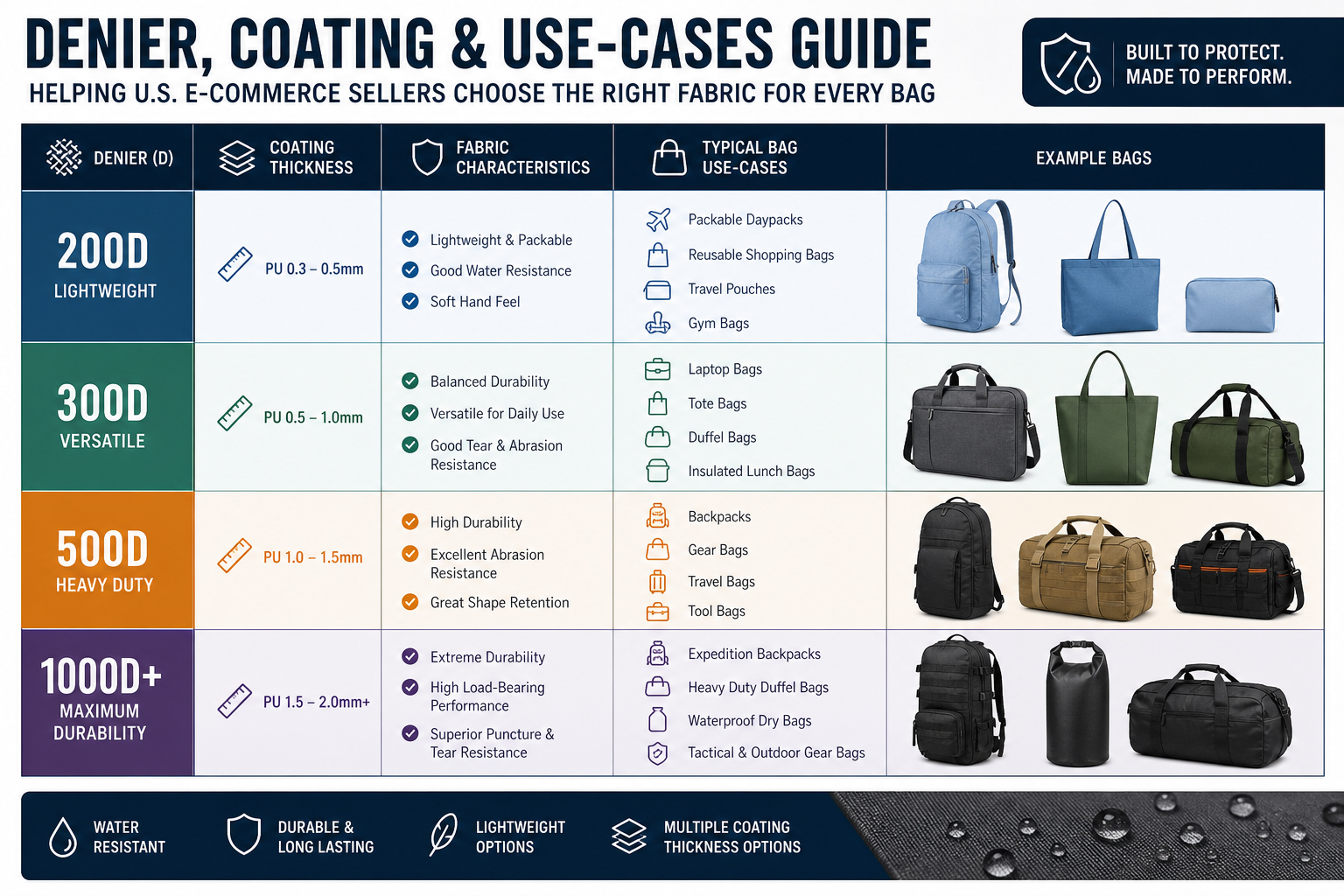
FOB Price Increase When Upgrading Fabric: 600D → 1680D Polyester and 0.6 mm → 1.2 mm PU
Material upgrades directly shift your China‑origin FOB unit cost, which further shapes your landed cost and final US retail price. The fabric cost jump comes from two dimensions: higher raw textile price, plus secondary manufacturing cost increases. Heavier high‑denier woven material is tougher to cut and slower to sew on production lines, adding modest labor overhead per finished unit.
Moving from baseline 600D polyester (roughly 200‑230 GSM fabric weight) up to 1680D polyester (approximately 380‑450+ GSM) pushes yard‑level fabric costs 30 %‑50 % higher. Translated to finished‑bag FOB unit pricing, real‑world price uplift commonly lands **$1.50 to $3.00+ per individual bag**. The exact delta depends on overall bag dimension, total fabric consumption per unit, bag complexity and order volume.
Likewise, boosting PU coating thickness from 0.6 mm to 1.2 mm adds material expense for extra polymer coating compound. It also changes material rigidity: very thick‑coated fabrics slow down sewing operations. Again, per‑bag FOB cost rises accordingly.
As a US independent‑site seller, you need to calculate whether this premium is justified by your market positioning. If your store competes on low‑price promotional backpacks, full‑scale upgrade to 1680D across the whole product will destroy profit margins. But for heavy‑duty tool bags or premium outdoor backpack listings targeting higher‑spending consumers, the price increase makes commercial sense and supports higher retail price tags and lower product‑return rates.
A money‑saving middle strategy many US importers adopt is partial‑zone material reinforcement: keep main bag bodies at cost‑effective 600D polyester, and only apply 1680D heavy‑duty fabric on high‑abrasion bottom panels, handle attachment points and shoulder‑strap anchor regions. You capture most durability improvement without paying full‑product‑grade premium FOB pricing. Always communicate this hybrid‑material requirement clearly within your quotation request and pre‑production sample approval documentation.
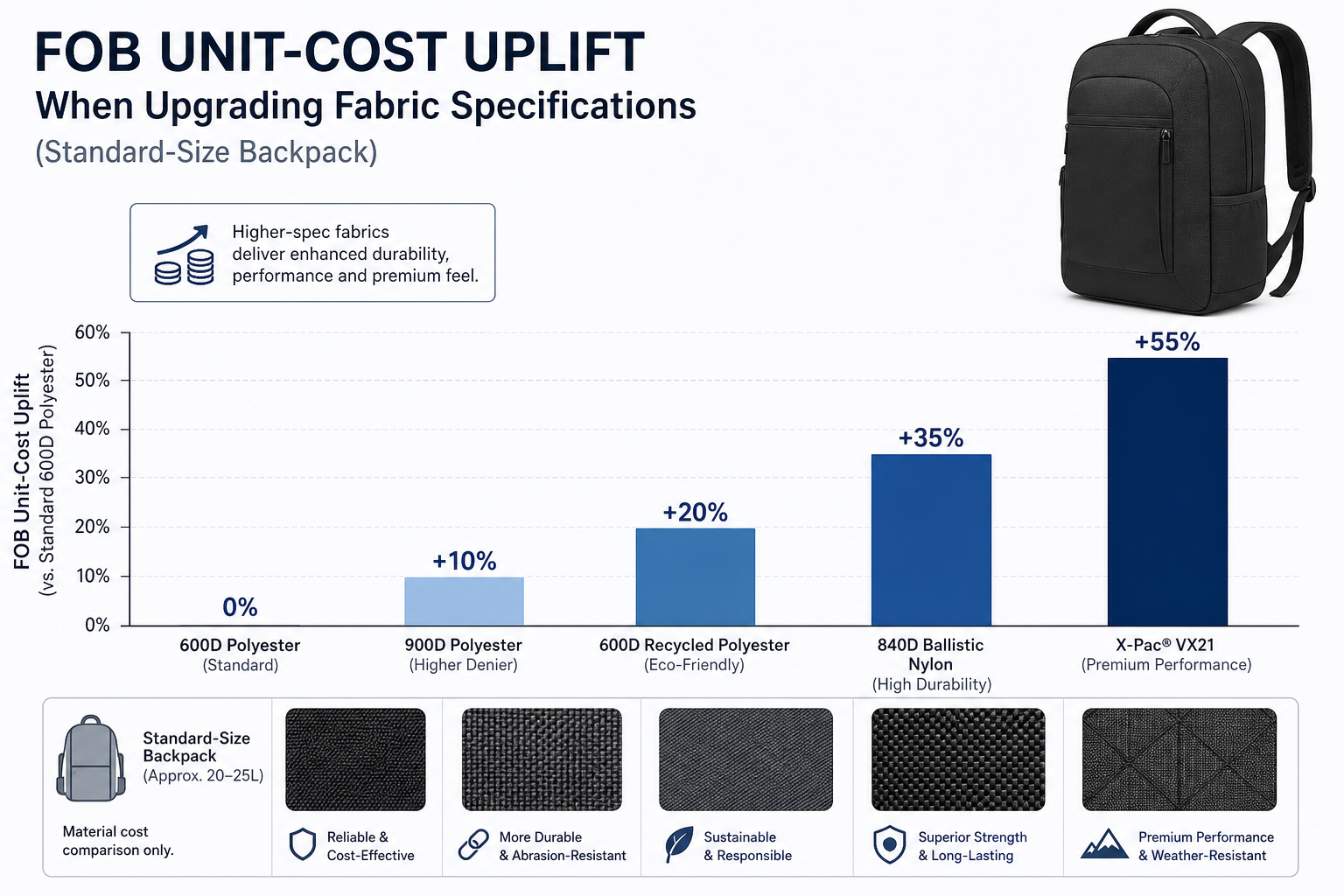
Do Higher‑Denier Fabric and Thicker PU Increase US‑Bound Shipping and Dimensional‑Weight Costs?
This is a financially vital topic for cross‑border importers shipping from China to USA. The short answer is yes. Higher‑denier fabric and thicker PU coating raise finished‑product actual weight, and this impacts both sea‑freight and air‑freight expenses. In general, upgrading material specifications can drive a finished‑bag weight increase translating to approximately **3 %‑5 % higher overall shipment weight**.
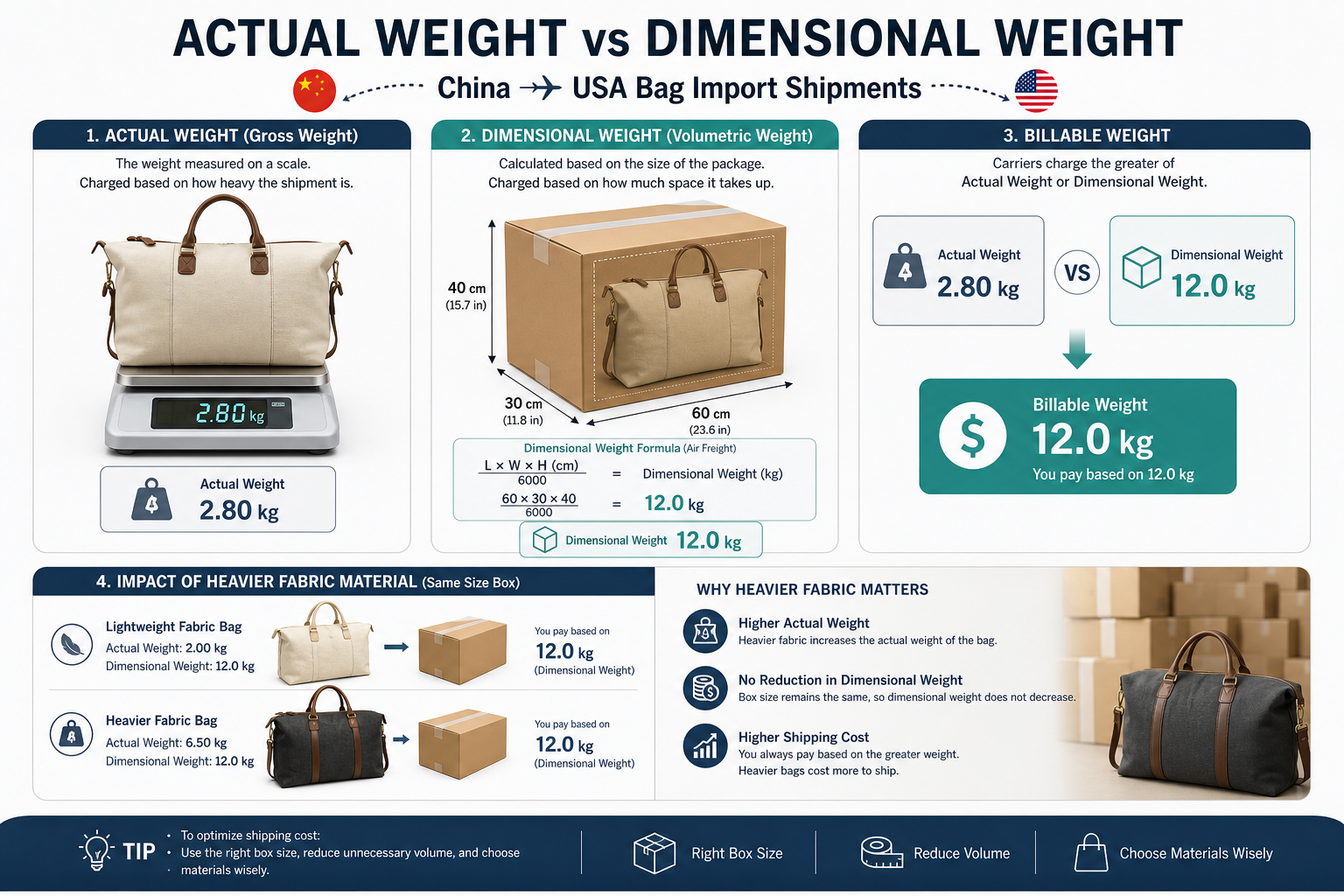
You need to distinguish two key logistics concepts: actual weight versus dimensional weight. Dimensional‑weight pricing is widely used by international couriers and air‑freight forwarders. Dimensional‑weight charges are calculated from carton outer dimensions, not item weight. If upgrading fabric does not change outer physical dimensions of finished bags and export cartons, dimensional‑weight calculation itself will not shift. However, the real physical weight of each carton goes up because each individual bag weighs more.
For sea container shipments, freight is charged mostly per‑container or per‑cubic‑meter volume. If your order fills a full container, moderate per‑unit weight increases rarely create huge extra sea‑freight expense. But for less‑than‑container‑load (LCL) ocean freight and especially air‑freight / express courier shipments, higher actual product weight directly pushes your total shipping bill upward.
Many US independent‑site sellers run small‑batch trial orders shipped via air freight. In this scenario, fabric‑driven weight gain hits your landed cost noticeably. You must model this extra weight factor during your early‑stage profit calculation, not only focus on FOB unit price from Chinese factories. It is a common pitfall: buyers negotiate a slightly higher FOB unit price for better fabric yet overlook corresponding inbound‑shipping cost increases, squeezing total profit margin unexpectedly.
Practical operational tip: when you evaluate two alternative fabric options, ask your Chinese supplier to provide finished‑product unit‑weight data for both material versions. Input these weight figures into your landed‑cost spreadsheet before finalizing fabric selection for your independent‑store product line.
Can Chinese Factories Produce Custom Denier or Custom PU‑Thickness Fabric for Low‑MOQ Trial Orders?
US merchants operating independent e‑commerce websites frequently want to test‑market new bag concepts with small‑volume trial runs. A natural question emerges: can Chinese bag OEM / ODM facilities accommodate fully‑custom denier values or custom‑tailored PU‑coating thickness under low‑MOQ trial‑order conditions?
The reality divides into two scenarios: using existing off‑the‑shelf stock fabric variants versus creating completely brand‑new custom‑formula textile.
For **standard‑range denier and coating‑thickness combinations that already exist within the mill’s stock fabric library**, factories can accept custom spec selection for low‑MOQ trial orders. You pick from pre‑produced textile swatches: for example requesting stock‑grade 900D polyester with 0.7 mm PU coating. No textile‑mill retooling is needed. The bag factory cuts and sews existing stock fabric to your bag pattern. This is very feasible for small trial batches.
However, if you require **completely non‑standard custom denier (for example 720D polyester that is not a common stock grade) or one‑of‑a‑kind custom PU‑coating thickness that requires textile‑mill re‑formulation**, the situation changes. Creating brand‑new custom fabric requires the textile mill to reset spinning machines, adjust coating production lines and run minimum fabric‑yardage orders. The fabric mill’s textile MOQ will often be several thousand yards minimum. This fabric MOQ requirement far exceeds the low‑volume bag‑trial‑order quantity of many US independent‑site sellers. In such cases, Chinese bag factories cannot support fully‑custom textile specs for tiny trial batches.
Best practice guidance for US‑based bag importers running low‑MOQ trials:
1. Work within existing standard‑stock denier and PU‑thickness options during your initial market‑testing phase.
2. Collect real‑world sales feedback and customer review data from your independent website.
3. Once sales volume scales sufficiently to absorb textile‑mill minimum yardage requirements, you can then invest in fully‑custom‑developed fabric for your larger‑volume production runs.
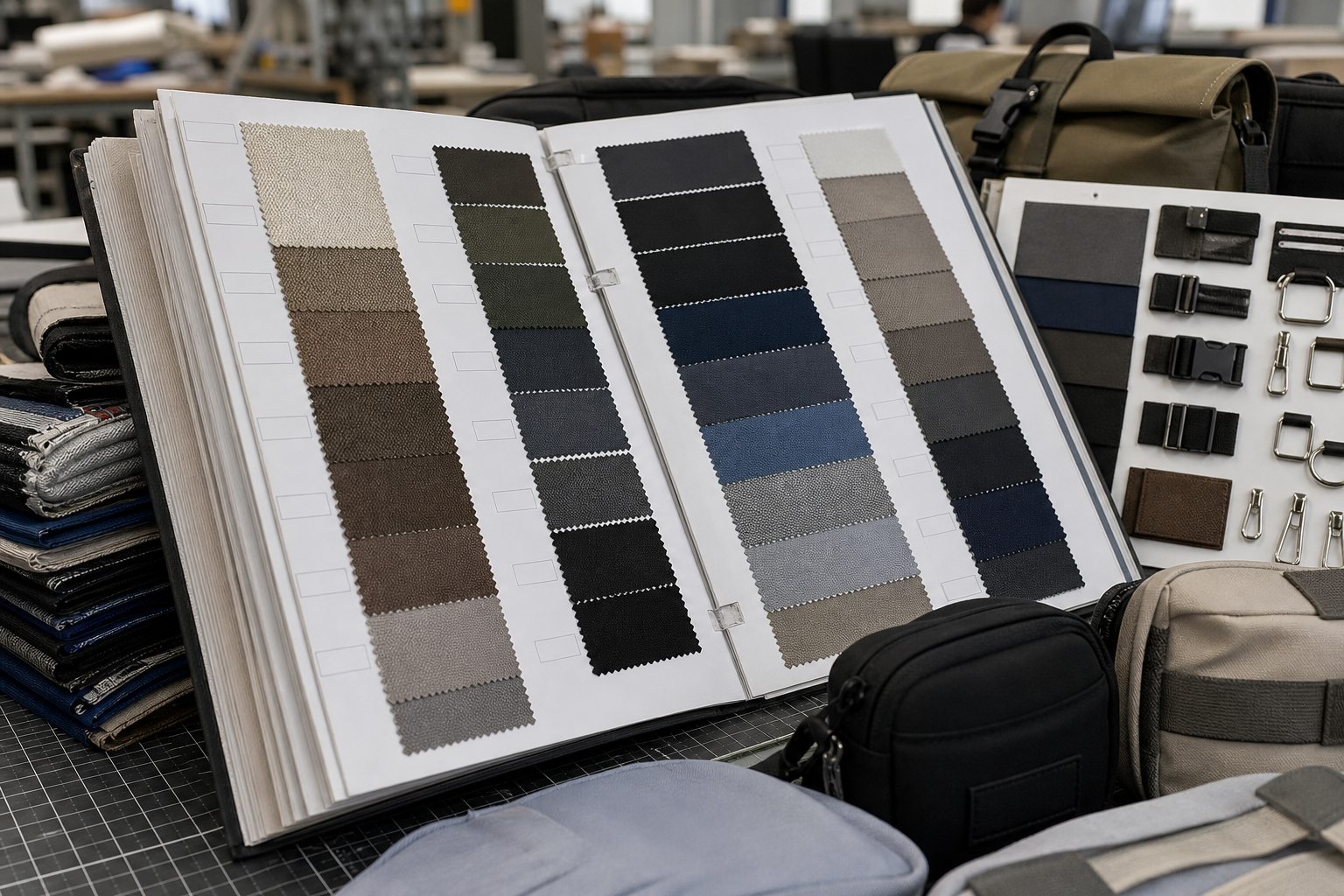
Some flexible mid‑sized Chinese bag OEM partners maintain inventory of multiple stock‑fabric variants. They can support diverse spec choices even for small‑batch ODM work, as long as you stay inside their existing fabric swatch catalog. Always request the supplier’s full fabric‑swatch book at early project stage to visualize all feasible stock‑material choices for your trial order.
Final Key Takeaways for US Independent‑Site Bag Buyers Sourcing in China
Sourcing custom‑manufactured bags from China for your American‑market independent website demands precise communication around fabric technical parameters. Denier rating and PU‑coating thickness are primary quotation specifications for Chinese OEM and ODM bag factories. Never send RFQs without stating both metrics clearly.
1. Standard stock‑fabric options cover polyester Oxford deniers 210D‑1680D and nylon grades 420D‑1050D, with PU coating ranging 0.3 mm‑1.2 mm. Match fabric selection to your product positioning: budget entry‑level, mid‑range commuter‑style, or heavy‑duty premium gear.
2. Upgrading from 600D polyester to 1680D polyester, or 0.6 mm PU up to 1.2 mm PU increases per‑unit FOB bag price, typically $1.50‑$3.00+ per bag, driven by higher raw‑material cost plus minor extra sewing‑labor expense. Partial‑panel heavy‑fabric reinforcement offers a balanced cost‑vs‑durability workaround.
3. Heavier‑denier and thicker‑PU materials raise finished‑bag actual weight, creating approximately 3 %‑5 % higher total shipment weight from China to USA. This increases air‑freight and express‑courier landed cost, though dimensional‑weight will stay unchanged if carton dimensions remain identical. Always include weight‑change impact within your landed‑cost calculation.
4. Low‑MOQ trial orders can select among existing‑stock standard denier and PU‑thickness variants. Fully‑custom non‑stock fabric requires textile‑mill large‑yardage minimums and generally is not viable for small test batches. Reserve fully‑custom textile development for after you validate product‑market fit with sales from your independent store.
When you submit requests for quotation, always attach your target full‑specification example: *1680D polyester Oxford, 0.8 mm PU coating, target fabric weight ~400 GSM*. Request physical pre‑production samples and fabric swatches before approving mass‑production. By eliminating fabric‑spec ambiguity, you reduce unexpected defects, costly re‑work, customer returns and protect your independent‑store brand reputation within the competitive US bag marketplace.
If you share details of your core bag categories (laptop backpacks, duffle bags, tool bags, tactical packs etc.) plus your target retail price brackets, we can further recommend optimized fabric‑spec combinations that balance durability, FOB cost and landed import expense for your US‑market independent website.
Post time: Aug-31-2026