
Published for US‑based bag e‑commerce sellers: key factory insights, performance benchmarks, supplier interview checklist, and compliance best practices
As an independent website bag retailer selling travel, outdoor and daily‑use bags to US consumers, product performance claims around water protection directly impact customer satisfaction, product reviews, and federal advertising compliance. Many US merchants source luggage, backpacks, commuter bags and outdoor dry bags directly from Chinese manufacturers. One of the most frequently misunderstood product features is fabric water‑repellent, water‑resistant, and waterproof coating technology. Many buyers assume “coated fabric” equals fully waterproof finished bags. In reality, coating type, coating quality, bag construction, seam treatment and hardware all define real‑world performance. This blog breaks down common Chinese factory coating options, lab testing benchmarks, long‑term real‑world durability, fabric hand‑feel trade‑offs, critical construction pitfalls, ready‑to‑use supplier survey questions, and a step‑by‑step sourcing workflow for US‑based bag sellers.
What Waterproof / Water‑Resistant Coatings Do Chinese Bag Factories Apply?
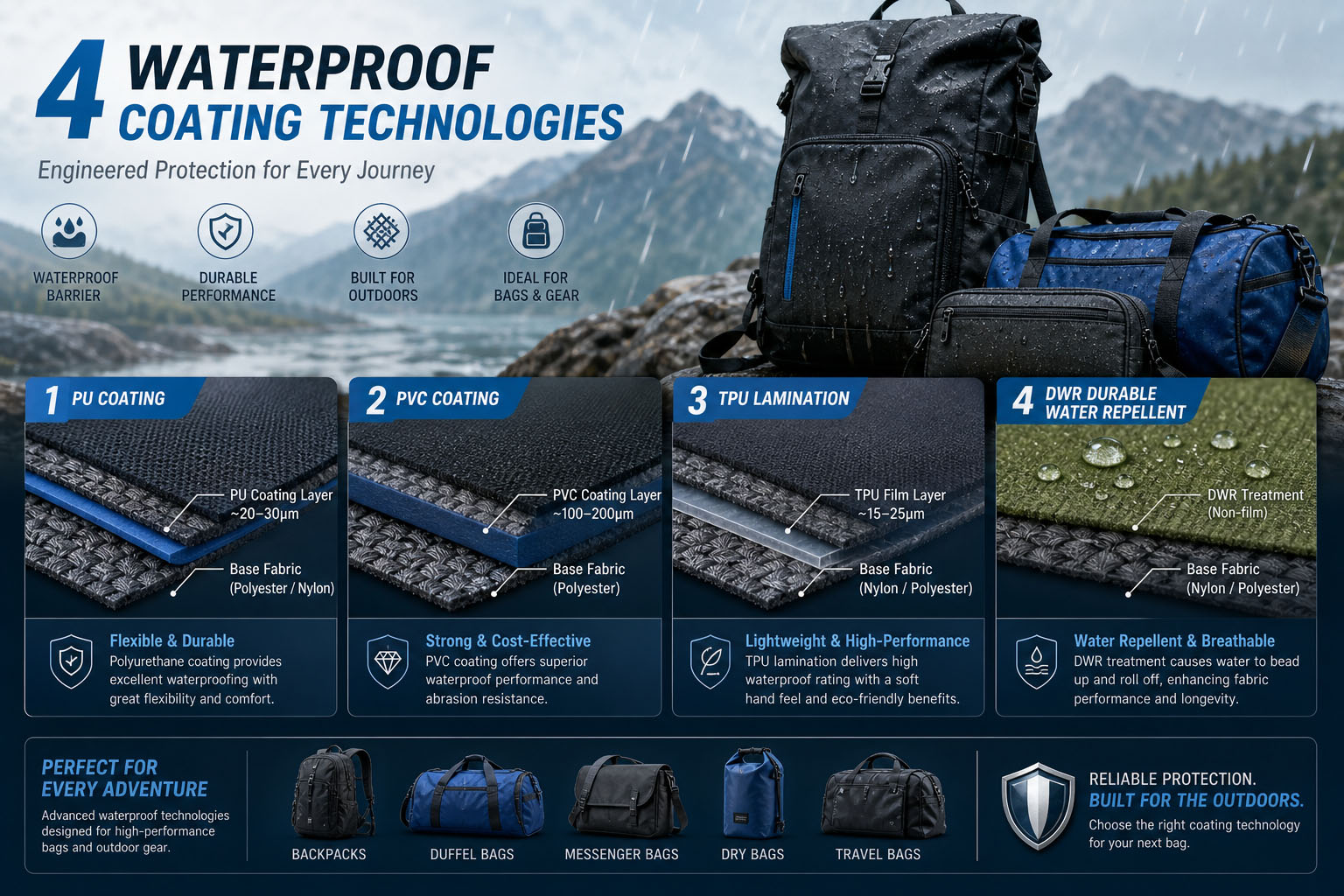
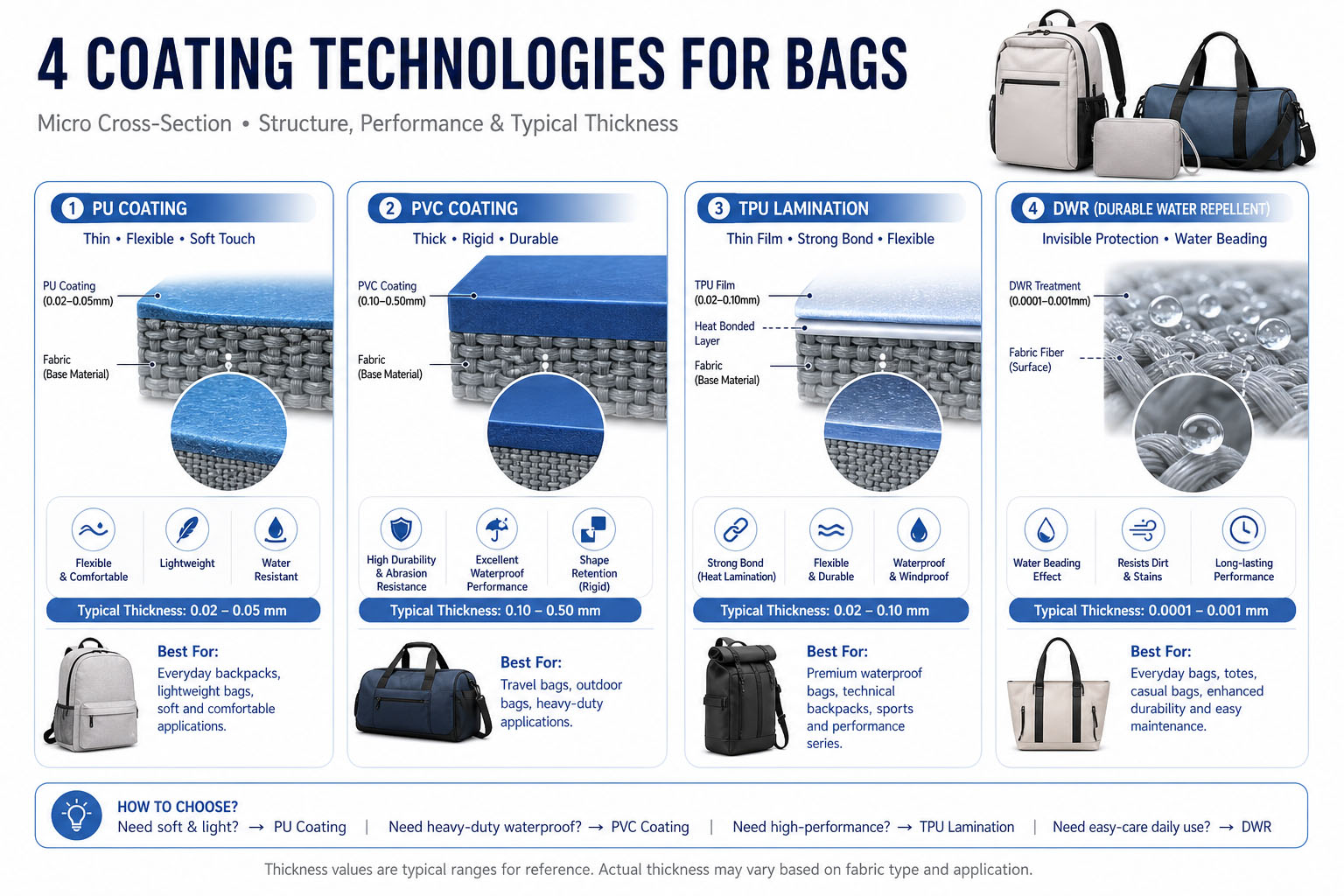
When sourcing travel, commuter and outdoor bags from China, factories can apply water‑resistant or waterproof treatments, but these functional finishes are **not included by default**. You must explicitly specify coating requirements in your product brief to your supplier. Chinese bag manufacturers work with four dominant coating technologies for polyester and nylon textiles: PU coating, PVC coating, TPU lamination, and DWR durable water repellent finish. Higher‑end factories also deploy water‑based eco‑coating formulations to meet global chemical compliance rules such as REACH and CPSIA for the US market.
**PU (Polyurethane) Coating**: This is the most widely adopted coating for mid‑range travel backpacks and daily commuter bags. Factories apply PU onto nylon, polyester and oxford fabric. PU delivers flexible performance, balanced weight and relatively better breathability compared to PVC material, making it ideal for everyday and travel‑oriented bag SKUs. Factories can tune PU coating thickness ranging from 0.02 mm to 0.05 mm to balance production cost, total bag weight and water‑repellent performance according to buyer requirements.
**PVC Coating**: PVC is a low‑cost waterproof layer heavily used for entry‑level price‑driven bag lines. PVC creates solid water barrier performance, yet it tends to add fabric weight, reduces material flexibility, and is less common for premium‑positioned merchandise sold on US independent websites.
**TPU (Thermoplastic Polyurethane) Lamination**: Premium outdoor and heavy‑duty dry‑bag producers select TPU lamination. Instead of surface paint‑on coating, TPU film is bonded to base fabric. TPU brings robust waterproof capability, suited for harsh outdoor and water‑activity scenarios.
**DWR (Durable Water Repellent)**: DWR is a surface finishing treatment rather than a thick barrier coating. DWR makes water bead and roll off fabric surface. It delivers surface water‑repellency, yet it cannot stop water penetration under sustained rain or water pressure. DWR is frequently added to outdoor‑style travel bags alongside PU or TPU base coatings.
Additional specialty alternatives include coated canvas and waxed canvas. These deliver vintage‑style water resistance, yet they require extra validation on seam leakage and long‑term coating stability before mass production runs.
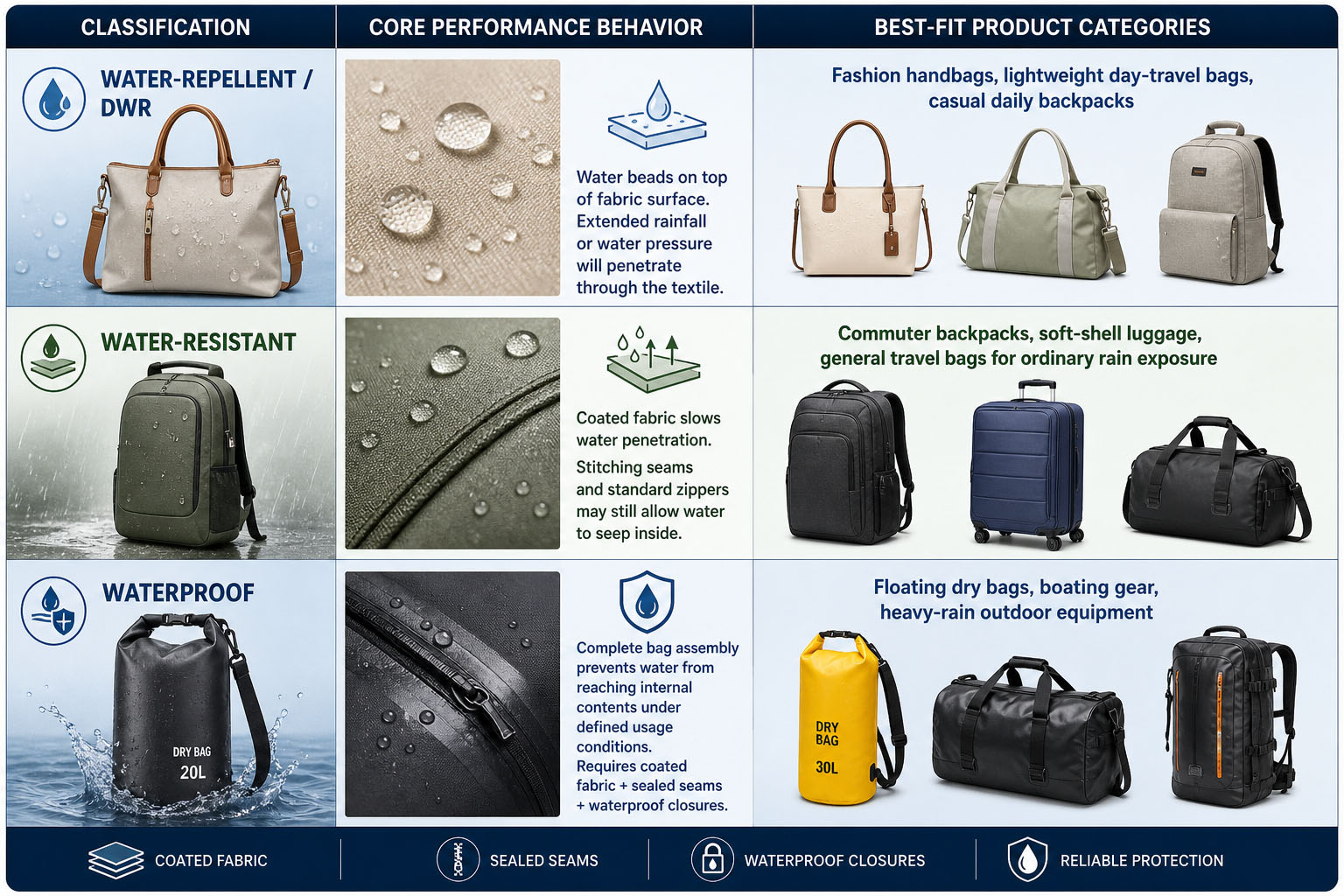
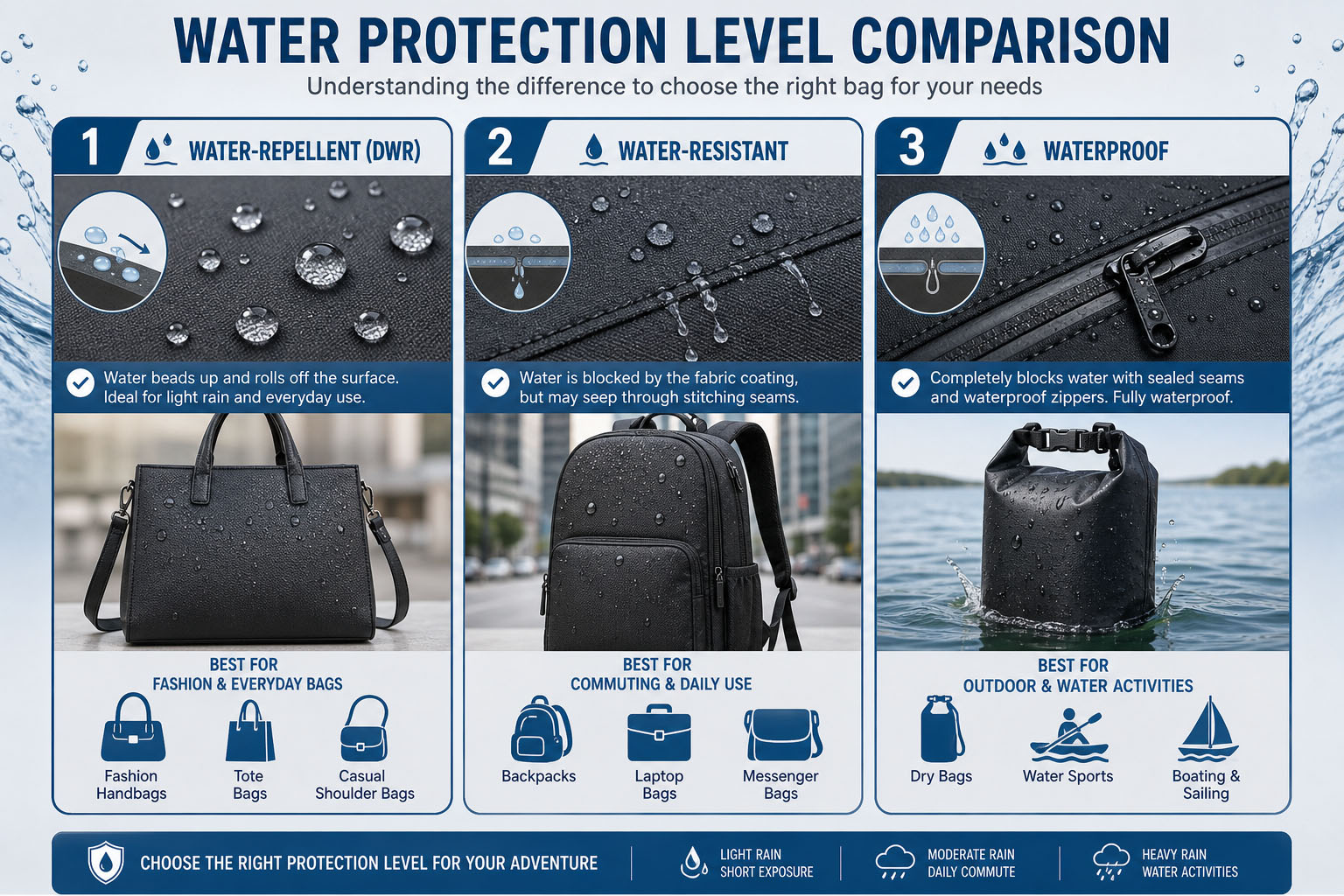
Critical industry insight: No fabric coating alone can create a fully waterproof finished bag. Sealed seams and matched waterproof zipper hardware are mandatory components for true waterproof performance. Even fabric with excellent hydrostatic head ratings will leak through stitching pinholes, zipper openings, handle attachment points and pocket seams without proper construction handling.
Water‑Repellent, Water‑Resistant, Waterproof: Clear Definitions for US E‑Commerce Merchants
Mislabeling these three terms creates serious compliance risk for US independent‑site sellers. Under US FTC 16 CFR 24.3 regulations, advertising an item as “waterproof” is deceptive if the finished product cannot block water ingress under reasonably expected real‑world usage conditions over its service life. It is vital for bag retailers to understand and correctly apply these three classifications for product listings, marketing copy and supplier specifications.
Two standardized test methods are regularly referenced by Chinese bag factories. **AATCC TM22 spray test** evaluates surface water beading performance for DWR‑treated fabrics. It measures surface wetting behavior, but it cannot prove that the complete assembled bag is waterproof. **ISO 811 (also AATCC 127) hydrostatic head test** measures how much water pressure fabric can withstand before water breakthrough occurs, expressed in millimeters (mm) hydrostatic head value.
Chinese travel and outdoor bag fabrics typically achieve hydrostatic‑head test values ranging from **1 500 mm up to 10 000 mm**. Higher hydrostatic‑head numbers correspond to stronger water‑blocking performance of the textile itself. Please keep in mind: fabric lab test results do not represent finished‑bag performance, as leakage points exist at every stitched seam and hardware cut‑out.
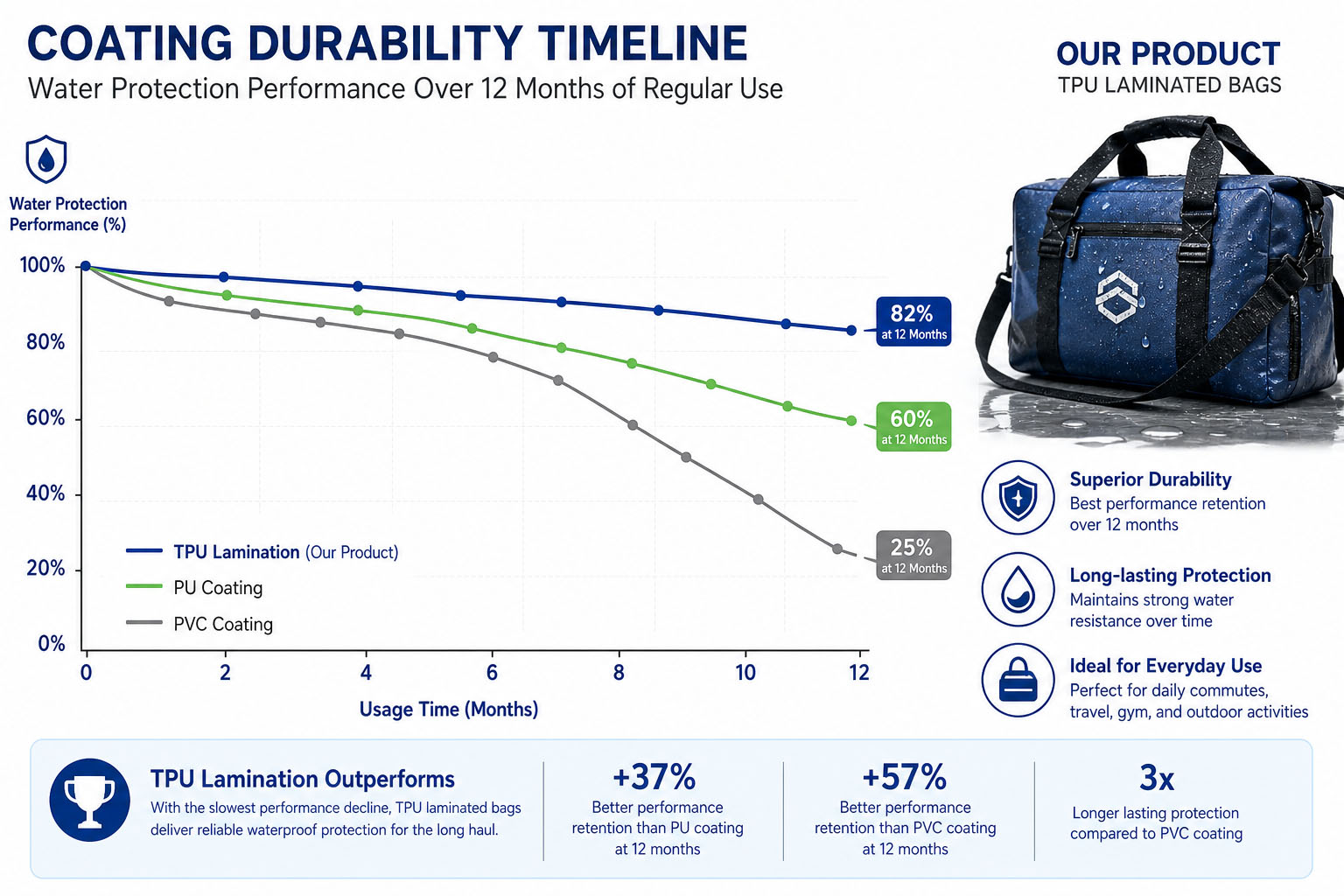
Real‑World Durability of Factory‑Applied Waterproof Coatings: 6‑12 Month Daily‑Use Outlook
A common concern for US bag buyers: how will factory‑applied water‑proofing coatings hold up under normal daily commuter and travel wear over six to twelve months, without catastrophic abrasive damage?
No functional coating lasts indefinitely. All factory‑applied water‑resistant coatings degrade gradually over time. Degradation drivers include surface abrasion from friction, ultraviolet sun exposure from outdoor travel, repeated folding, and cleaning or washing cycles.
If the bag receives typical everyday use, without heavy scraping or repeated machine‑washing:
1. PU‑coated travel and commuter bags maintain most of their water‑resistant performance through 6‑12 months of regular usage. Surface DWR bead‑off effect will fade more quickly; underlying PU barrier coating still delays water penetration.
2. PVC‑coated material retains barrier capability well, but risks stiffening and surface micro‑cracking after prolonged folding and sun exposure.
3. TPU laminated fabric delivers superior long‑term water‑holding performance for outdoor‑focused SKUs, compared to spray‑on or paint‑style coatings.
Important note to communicate with your Chinese supplier: you need to confirm expected coating lifecycle, and whether end‑users can restore repellency with aftermarket spray‑on re‑treatment products after performance diminishes. Do not rely solely on fabric lab reports; simulated abrasion testing and real sample field testing give far more accurate expectations of 6‑12‑month real‑world outcomes.
Misconception correction: “No abrasion” conditions in lab specifications do not mirror real‑world travel use. Bags rub against shoulders, airport conveyor belts, furniture and ground surfaces in daily operation. Even moderate non‑destructive friction slowly reduces surface DWR performance.
How Waterproof Coatings Impact Fabric Hand‑Feel, Breathability & Custom Logo Printing
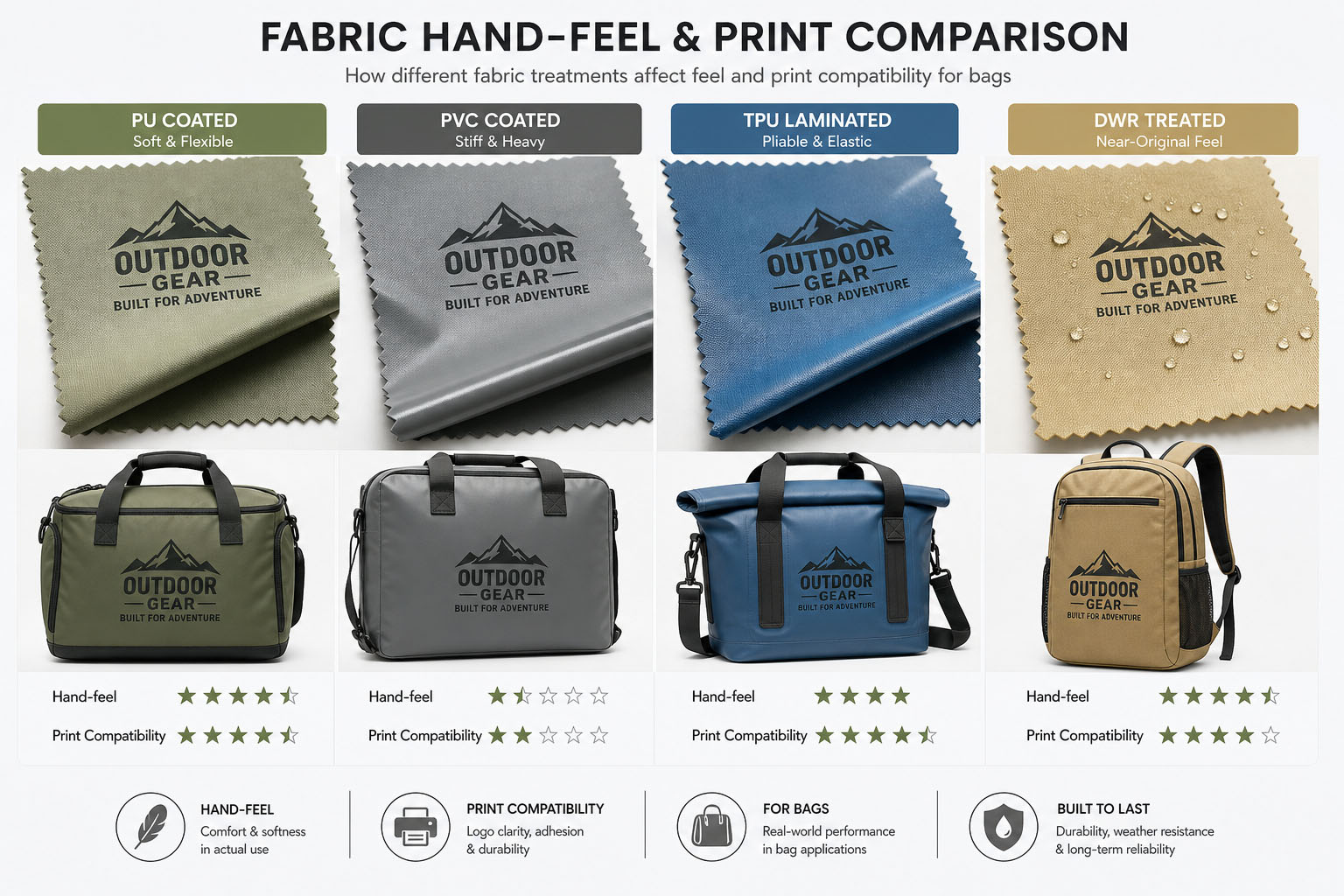
Many US custom‑order bag buyers worry whether waterproof coatings ruin fabric touch, reduce breathability, or create problems for custom logo branding. In general, properly selected factory‑applied coatings **do not automatically ruin hand‑feel, kill breathability or block custom logo printing**, but trade‑offs exist depending on coating variant and coating thickness.
**Hand‑feel**: Thin‑formula PU coatings preserve soft, flexible fabric hand‑feel. Thicker PVC tends to make fabric stiffer and heavier. TPU lamination can vary: premium thin‑film TPU stays pliable, while heavy‑gauge TPU feels rigid. DWR surface finish almost does not alter fabric tactile sensation. Over‑thick coating specifications will create a rubbery, plasticky hand‑feel, so you should request physical swatch samples to evaluate touch before mass production.
**Breathability**: PU coating offers noticeably better breathability compared to PVC coating, which is why PU is preferred for daily‑carry and travel backpacks. DWR treatment keeps original fabric breathability almost unchanged. TPU lamination varies by film grade; fully impermeable TPU dry‑bag fabric sacrifices breathability for maximum water‑blocking effect.
**Custom logo printing compatibility**: Most standard PU, DWR and thin‑TPU treated fabrics work normally with screen printing, heat‑transfer printing and embossed logo customization. Heavy‑PVC coated textiles can present adhesion challenges for certain print techniques. Always send your intended logo artwork to your Chinese factory and run pre‑production print tests on the exact coated fabric swatch you will use for bulk goods, to avoid mass‑order branding defects.
Never make assumptions based on product descriptions. Physical swatch sampling is the most reliable way to assess hand‑feel, breathability and print compatibility for your specific bag project.
Beyond Fabric Coatings: Critical Bag Construction Details That Define Real‑World Waterproof Performance
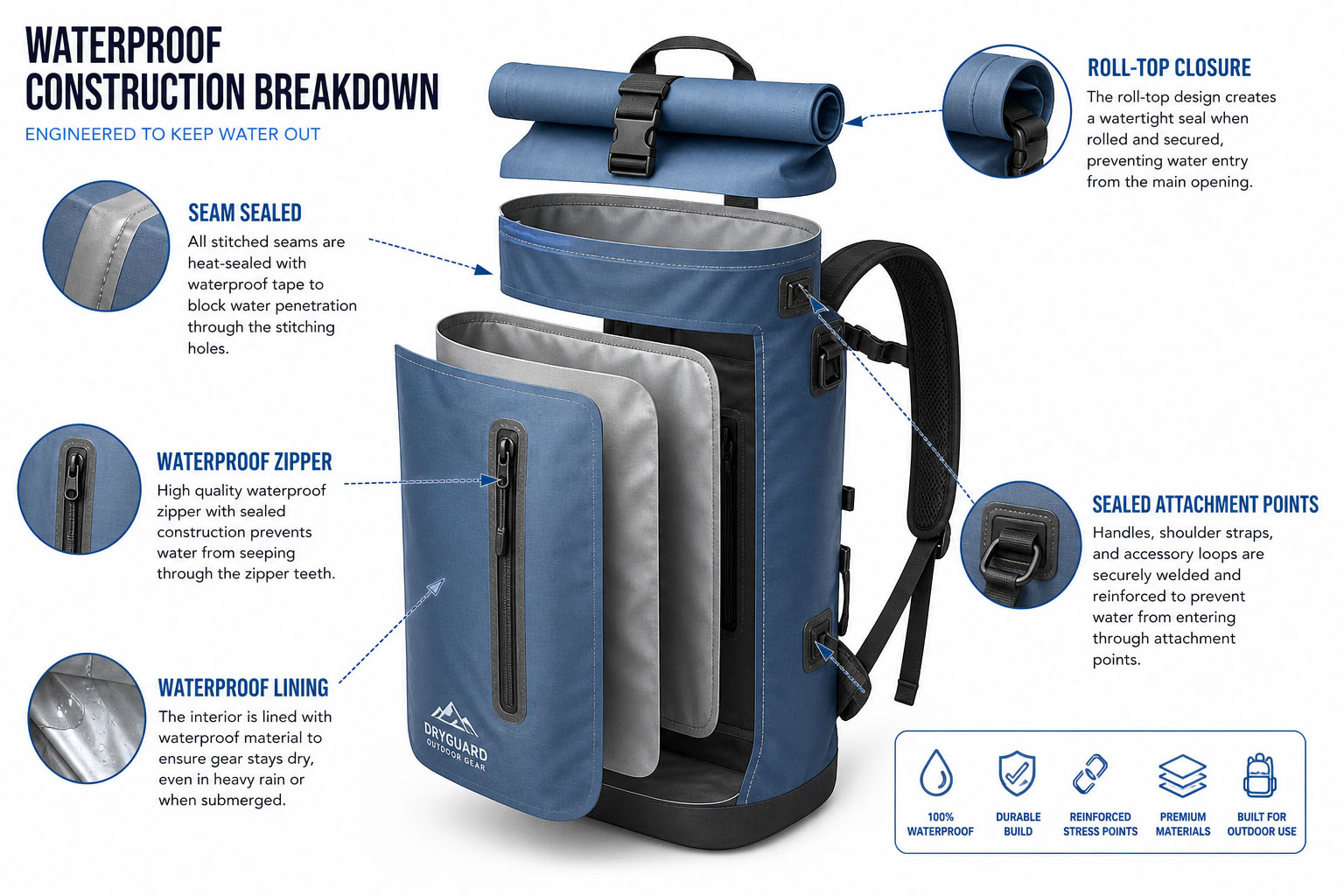
Functional coating on textile is only one piece of the puzzle. Even top‑grade coated fabric will leak water if overall bag assembly is poorly engineered. When negotiating with Chinese bag factories, explicitly ask about these construction features for your travel / outdoor bags:
1. Seam treatment: plain stitched seams, seam‑sealed tape, or high‑frequency welded seams. Welded and seam‑taped seams close pin‑holes created by sewing needles.
2. Zipper specification: genuine waterproof zippers, or regular zippers only covered by fabric storm flap. A zipper flap offers partial splash protection but cannot deliver full waterproof performance.
3. Storm‑protection structures: roll‑top closure, external storm flap for main compartment openings.
4. Reinforced and sealed attachment points for handles, shoulder straps and D‑rings; these are common hidden leakage points.
5. Inner lining or dedicated waterproof inner compartments as needed by your product design.
For reference: general daily‑use travel and commuter bags commonly specify PU‑coated 600D polyester or nylon fabric plus zipper storm flaps and reinforced stitching. For outdoor water‑sport dry‑bag‑style items, you should specify TPU or heavy‑duty PVC‑coated textile paired with welded or seam‑taped seams, alongside genuine waterproof zippers.
Complete Supplier Questionnaire to Send to Chinese Bag Manufacturers
Copy‑paste this checklist directly into your email or chat messages with your sourcing factories to eliminate ambiguous verbal commitments. Get written confirmation for every point for your purchasing records.
Please confirm the following technical details for this bag model:
1. Is the finished bag water‑repellent, water‑resistant, or fully waterproof?
2. Please state fabric composition and denier rating, for example: 300D, 600D, 900D polyester or nylon.
3. Which coating or finishing treatment is applied? (PU / PVC / TPU lamination / DWR / other)
4. What is coating thickness, or hydrostatic‑head test rating for the fabric?
5. Are seams simple stitched, seam‑tape sealed, or high‑frequency welded?
6. Are zippers waterproof grade, or merely covered by a zipper flap?
7. Can you provide test reports generated against this exact finished bag product (not raw fabric only)?
8. What official test standard is used: AATCC TM22, AATCC 127, ISO 811, or alternative standard?
9. How will water‑protective performance change after washing, surface abrasion, repeated folding and regular consumer usage? Is post‑use re‑treatment possible?
10. Can you supply a pre‑production sample matching mass‑production fabric, coating, hardware and construction for independent water‑performance testing before bulk manufacturing starts?
Step‑by‑Step Sourcing Workflow for US Independent‑Site Bag Sellers
Follow this workflow to reduce product returns, bad customer reviews, and FTC compliance risks for your travel and outdoor bag line sourced from China:
1. **Order pre‑production sample matching mass‑production specifications**: The sample must use identical fabric, coating treatment, zipper hardware, lining material and seam construction as planned bulk goods. Testing loose fabric swatches alone is insufficient; full assembled‑bag performance is what matters for your end‑consumer.
2. **Run hands‑on water testing on the complete physical sample**: Place dry paper tissue inside the sample bag. Spray or shower the exterior of the bag. Inspect internal contents and all seam locations for water ingress. This practical test catches real‑world leakage that fabric‑only lab reports will miss.
3. **Request third‑party independent lab test reports**: If you intend to market your product as “waterproof” on your US‑based website, obtain third‑party lab verification. Relying only on factory‑issued internal test reports carries compliance risk.
4. **Embed all technical requirements into your formal purchase order**: Write down fabric type, coating specification, seam construction method, test standard reference, and acceptable defect rate in your PO document. This creates enforceable written requirements for your Chinese manufacturing partner.
5. **Apply careful wording on your website product listings**: Use “water‑resistant” for most travel and commuter bags. Reserve the “waterproof” product claim exclusively for SKUs that have passed full finished‑bag waterproof validation. Misleading waterproof advertising can trigger US regulatory action and consumer class‑action complaints.
Final Takeaways for US Bag Importers
Sourcing water‑protected travel and outdoor bags from Chinese factories brings abundant product options, but functional performance does not happen automatically. PU, PVC, TPU and DWR each bring distinct strengths and limitations for different price‑point and usage scenarios. Hydrostatic‑head fabric metrics are useful reference numbers, yet overall bag construction (seams, zippers, closures) ultimately decides real‑world anti‑leak performance.
Factory‑applied coatings degrade gradually over six‑to‑twelve‑month daily commuter and travel usage under normal real‑world wear. Appropriate coating selection does not automatically ruin fabric hand‑feel, breathability or custom logo printing, but physical swatch and pre‑production sample evaluation remains non‑negotiable.
For US independent‑site merchants selling cross‑border imported bags: treat waterproof‑related product claims seriously. Collect written supplier answers, test complete finished samples, and write functional specifications into purchasing documents. These practices protect your brand reputation, lower return rates, and keep your e‑commerce store compliant with United States advertising regulations.
Post time: Aug-19-2026