
For US bag merchants sourcing inventory directly from Chinese manufacturers, barcode, UPC and master carton labeling compliance is far more than a packaging detail. Incorrect barcodes, misprinted carton marks or non‑retail‑compliant labels trigger warehouse receiving failures, Amazon FBA rejection, big‑box retailer charge‑backs, production rework and costly shipment delays. Many new importers assume Chinese factories will automatically produce retail‑ready barcode and carton labeling. In reality, compliant labeling only happens with clear specifications, proper ownership of GS1 identifiers, pre‑production alignment on costs, and pre‑shipment quality checks. This guide breaks down core questions US bag buyers face when sourcing bags from China, clarifies legal ownership of UPC codes, retailer‑mandated labeling rules, fee structures, liability for label errors, and actionable workflows to guarantee smooth warehouse and retail receiving.
Core Foundational Knowledge: Barcode & UPC Realities For Chinese Bag Manufacturing
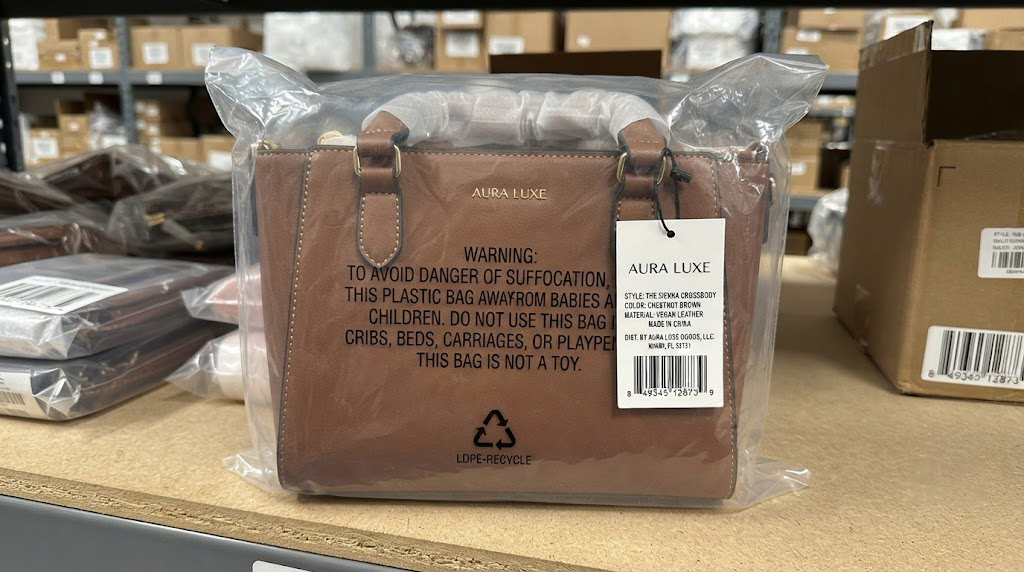
Established Chinese bag manufacturers are technically capable of printing GS1‑compliant barcode symbologies including EAN‑13, UPC‑A and Code 128 for US retail shipments. However, this service is never activated by default. Every labeling requirement must be formally communicated to your supplier in purchase orders and dedicated packaging specification documents. Small‑scale workshops and general trading companies frequently lack standardized internal labeling workflows; these suppliers rely entirely on item‑by‑item, explicit written instructions from the US importer to avoid non‑compliant output.
It is critical to separate two distinct activities: **generating / legally assigning UPC identifiers**, versus **physically printing and applying barcode labels onto units and export cartons**. Chinese factories excel at the printing and application step, yet they hold no legal authority to originate valid UPC codes for US retail distribution.
Key industry insight: Barcode print‑quality validation following ISO/IEC 15416 standards for scan reliability is not standard practice among Chinese bag producers. Factories will not run formal barcode scan verification unless you write this requirement into your contract and pre‑shipment inspection scope. Without contracted scan testing, visually correct barcodes can still fail scanner readability at US warehouses and retail distribution centers.
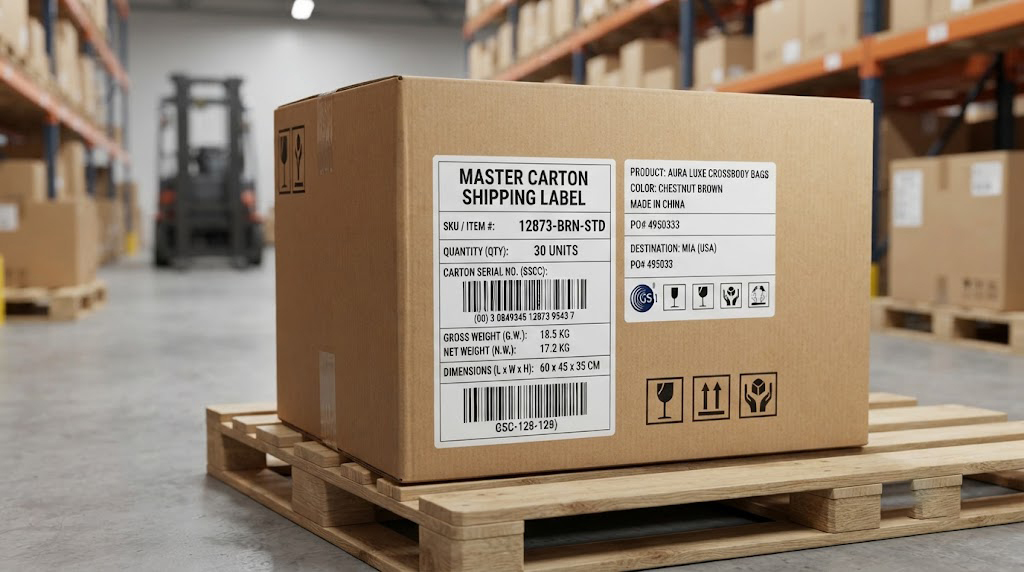
For export master cartons, experienced bag exporters follow GS1 and ANSI/AIAG carton‑marking conventions when buyers supply complete specification sheets. Standard mandatory carton information fields include internal buyer SKU, unit quantity per carton, sequential carton numbering, gross weight, net weight, outer carton dimensions, and country‑of‑origin marking. These base carton markings satisfy general 3PL and independent‑website warehouse receiving workflows. They do **not** automatically meet enhanced labelling rules enforced by large US retail marketplaces and big‑box brick‑and‑mortar chains.
Regulatory markings such as CPSC safety identifiers, California Proposition 65 warnings, and FDA‑related markings are entirely separate from barcode and carton label systems. US bag importers must list these compliance markings independently within purchase order and packaging documents, as they operate under separate US regulatory frameworks and are not covered by standard barcode specifications.
Four Critical Questions Every US Bag Importer Must Resolve With Chinese Suppliers
When you negotiate with Chinese bag factories for direct import, four high‑risk labeling questions repeatedly appear during supplier discussions. Resolve all four topics before mass production begins to eliminate receiving failures, unexpected expenses and supply‑chain disruptions.
1. UPC Ownership: Who Legally Holds the UPC Code, GS1 US Importer Registration vs Chinese Supplier Assignment
This is the most frequently misunderstood compliance point for US bag merchants.
UPC‑A barcodes used for US retail are governed by GS1 standards. Under US GS1 rules, valid UPC identifiers must be registered under the legal entity that owns the brand for retail sale, which in nearly all cases is the US‑based importer through GS1 US membership.
Chinese bag suppliers possess printing capabilities: factories can render, print and stick UPC barcode graphics onto hangtags, polybags or printed packaging. What they **cannot legally do** is originate, assign or sell you brand‑new UPC numbers for your bag SKUs. Any Chinese vendor offering to “provide you with UPC codes” creates major downstream risk. If you use third‑party resold UPC numbers not registered to your business entity, marketplaces including Amazon, Walmart and Target perform GS1 ownership validation and will suppress your listings or reject inbound shipments.
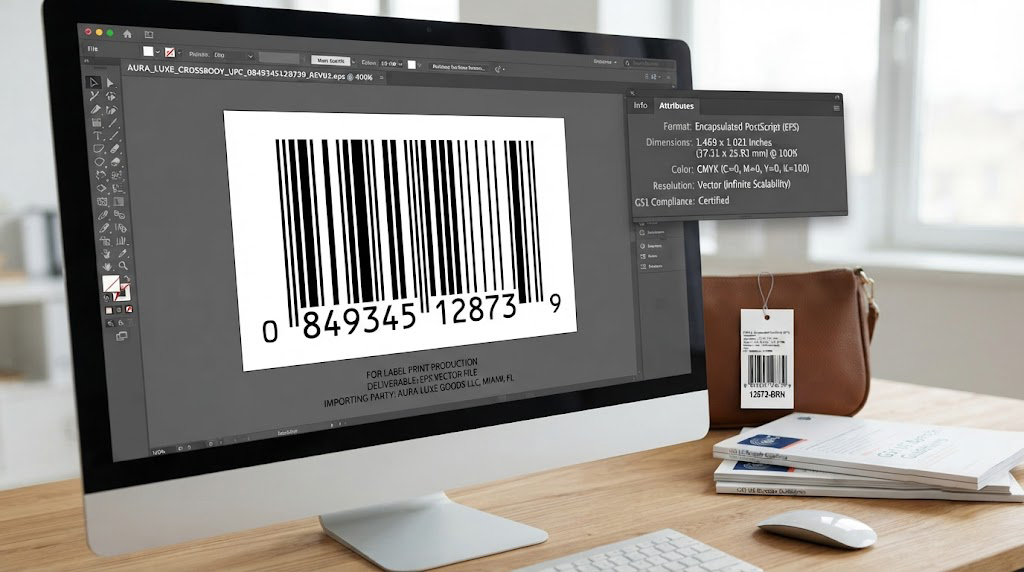
There are rare negotiated exceptions. In limited private‑label scenarios where the Chinese factory’s own brand is sold into the United States, the factory may hold its own GS1 prefix. For 95 % of US independent‑site sellers importing private‑label bags, best practice remains: the US importer secures GS1 US membership, obtains unique UPC numbers for every bag variant (per style, colour and size), exports high‑resolution vector barcode files in EPS or PDF format, and delivers these digital assets to the Chinese bag manufacturer for printing only.
In commercial practice between US buyers and Chinese bag manufacturers, ownership arrangements are openly discussed and mutually confirmed during pre‑order communication. Your supplier will document whether you provide complete GS1‑registered barcode assets, or whether special brand‑ownership conditions apply. Never proceed to mass production without written confirmation of UPC ownership responsibility in your order paperwork.
2. Retailer‑Specific Labeling Mandates: Amazon FBA, Walmart and Target Requirements For Bag Shipments
Generic GS1 barcodes and basic carton markings will work for your own independent‑website warehouse fulfilment. As soon as you route inventory to major US retailers and marketplaces, you must add retailer‑specific labelling rules. Chinese factories will not automatically know these variable retailer rules; it is the US importer’s responsibility to submit complete technical labeling specifications prior to production kick‑off.
Amazon FBA requirements for bags
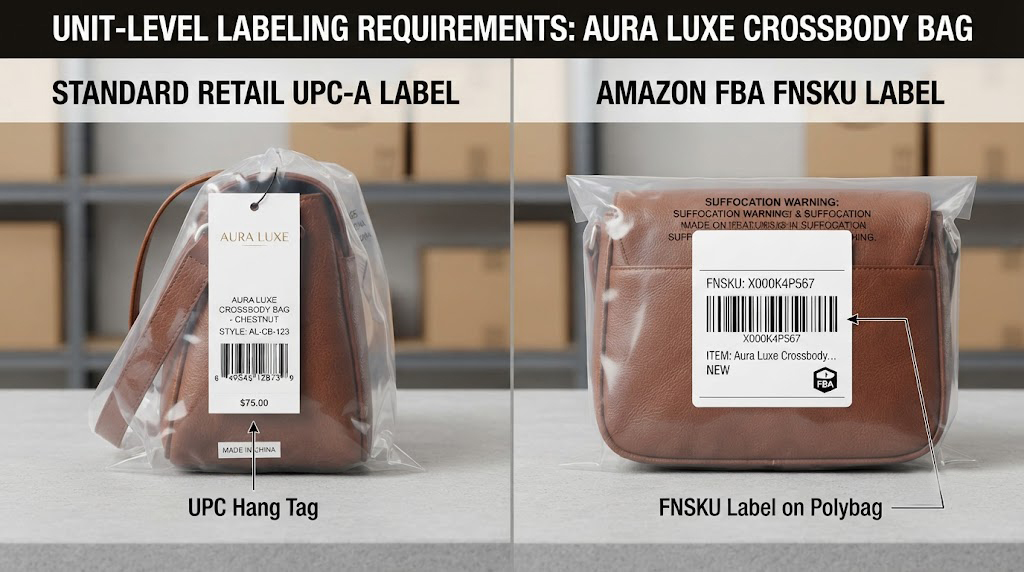
Per‑unit goods need scannable FNSKU labels applied to each bag or outer polybag, replacing or overlaying existing manufacturer barcodes to avoid scanner conflicts. Only one active scannable barcode may show on the outermost unit packaging. For inbound master cartons, Amazon requires unique FBA shipment ID box labels affixed to carton exteriors. Chinese factories or in‑China third‑party prep service providers can print and apply FNSKU and FBA box labels, but you need to supply generated label PDF files from your Amazon seller central account. Polybagged bags also carry Amazon‑mandated suffocation warning print requirements that must be included in your spec sheet.
Walmart and Target big‑box retailer rules
Walmart and Target enforce strict ASN‑linked carton labelling, PLN pallet/carton labels, sequential carton numbering and rigid barcode print‑quality standards. Shipments arriving without compliant retailer‑generated carton identifiers will be refused at distribution centres or incur heavy non‑compliance charge‑backs. Many big‑box programmes also require origin marking, importer identity information and, for children’s bags, permanent CPSC tracking labels. These retailer‑generated label templates cannot be guessed by Chinese manufacturers; you must download official templates and pass full datasets to your bag supplier.
Important distinction: Your baseline UPC covers product‑level retail scanning. FNSKU, PLN and ASN carton identifiers are separate marketplace‑ or retailer‑generated identifiers. You need to communicate all of them clearly in your packaging spec document.
Practical note: Many Chinese bag suppliers do not handle highly complex big‑box retailer label workflows in‑house. When factory internal capabilities are limited, you can leverage China‑based 3PL prep partners to perform barcode stickering, carton labelling and QC work after factory production finishes and before ocean or air export shipping.
3. Extra Charges: Barcode Printing, UPC Application and Custom Carton Marking Fees From Chinese Bag Factories
Barcode‑related processing is not always included inside standard unit production pricing for bags. US importers should expect potential incremental costs for three service categories: barcode label material and print labour, manual application labour for stickers onto hangtags, polybags or bag surfaces, plus custom‑formatted master carton sticker production.
Well‑run Chinese bag exporters follow transparent commercial practice: all anticipated extra labelling fees are discussed, itemised and mutually confirmed with the US buyer **before or during order confirmation**, not presented as surprise charges after manufacturing is underway.
Fee scenarios vary by supplier type:
1. Larger established bag factories with in‑house sticker printing equipment charge modest per‑unit or per‑carton labour fees for printing and affixing custom barcode and carton labels. If barcodes can be integrated directly into existing hangtag or packaging offset printing plates, incremental costs can be minimised.
2. Small workshops without on‑site label printers outsource sticker printing to local Chinese print houses, passing those external service fees to the buyer.
3. If you supply pre‑printed physical sticker sheets to the factory, charges drop to only manual application labour.
UPC registration itself is never billed by your Chinese supplier. UPC membership and number acquisition fees are paid directly by the brand‑owning US importer to GS1 US. Do not confuse supplier label‑printing service fees with GS1 registration costs.
If your order includes complex multi‑variant SKUs, mixed carton configurations or retailer‑specific special carton formats, request a line‑item quotation for all labelling‑related work as part of your initial order quotation round.
4. Liability Framework: Who Pays Costs For Misprinted, Non‑Compliant Labels, Rework and Shipment Delays
Label print errors, wrong barcode data, incorrect carton marking information or poor barcode print quality occasionally happen during mass production. This creates tangible losses: costs for re‑printing labels, labour for rework application on finished goods, and potential ocean/air shipment postponement charges.
Contract terms between US buyers and Chinese bag manufacturers need to explicitly allocate risk for these failure scenarios. Reputable Chinese bag factories accept responsibility for defects originating on their side: when the supplier misprints label artwork you correctly provided, mis‑types carton data from your specification sheet, or produces barcodes that fail scan‑testing, the factory bears corresponding costs for re‑printing, product rework, and resulting shipment‑delay‑related expenses.
Important caveats limiting factory liability:
- If label mistakes stem from incorrect artwork, wrong data files or incomplete specifications delivered by the US buyer, cost responsibility falls to the importer.
- If you skip pre‑production label proof approval and give direct mass‑production go‑ahead, liability rules will shift accordingly.
Best practice workflow to mitigate dispute risk: after your supplier generates draft label and carton‑mark artwork, require photographic physical proofs of sample labelled bags and sample export cartons before full‑scale manufacturing starts. Lock in this proof‑approval step within your purchase order terms. Also add barcode readability inspection tasks to your pre‑shipment inspection (PSI) checklist. Your PSI inspector must physically verify three points: barcode scan performance, correct physical label placement on units and cartons, and full alignment between carton markings versus packing list and commercial invoice data.
Step‑by‑Step Workflow To Achieve Reliable Warehouse & Retail Receiving For Imported Bags
Drawing together all labeling considerations, use this structured process when placing bag orders with Chinese manufacturers, whether you sell on your independent website, Amazon FBA or big‑box retail channels.
1. Finalise your overall barcode strategy first. Confirm your GS1 US membership, assign unique UPC‑A codes for every single bag SKU variant (style, colour, size). If you plan Amazon sales, plan for FNSKU label workflows separately from base UPC identifiers. Export high‑resolution EPS / PDF vector barcode files for all SKUs. Do not send low‑resolution JPG image files for barcode production; raster images frequently create un‑scannable finished labels.
2. Compile a complete **Packaging & Labeling Specification Sheet**. This document is your single source‑of‑truth sent alongside every purchase order to your Chinese bag supplier. Include these sections:
- Precise “Made in China” country‑of‑origin placement to satisfy US FTC Fair Packaging and Labeling Act import rules; include required importer contact information where applicable.
- Barcode symbology type, physical print dimensions, exact placement location for each finished bag unit (hangtag, polybag sticker, direct‑print position). Specify that only one functional scannable barcode shall appear on outermost unit packaging.
- Full master carton labelling template: define every data field, label physical size and sticking position on export cartons. Attach reference template files for retailer‑specific labels such as Amazon FBA box IDs, Walmart PLN labels if applicable.
- List all additional regulatory markings: Proposition 65 warnings, CPSC tracking labels for children’s bags, suffocation warnings for polybag packaging.
- Explicit requirements for pre‑shipment sample photo proofs for labelled product units and finished carton samples.
- Mandate barcode scan‑testing requirement if you require ISO/IEC 15416 print‑quality validation.
3. Confirm supplier capabilities during early supplier vetting. Pose four concrete qualification questions in writing:
- Can you apply UPC‑A / EAN‑13 or FNSKU barcodes onto each individual bag unit? Please confirm whether printing happens onto hangtags, direct packaging or adhesive stickers.
- Are you capable of producing master carton labels matching US retail and 3PL warehouse specifications? Can you work with retailer‑specific label templates supplied by buyer?
- Will you accept digital high‑resolution EPS / PDF barcode files provided by our US‑side team?
- If in‑house labelling capacity is insufficient, can you coordinate with trusted China‑based third‑party prep service providers to complete all labelling work prior to export?
4. Lock down commercial and liability terms in your PO. Confirm all extra labelling‑related fees in writing. Clarify UPC ownership status, and document fault‑based cost allocation for label‑rework and delay expenses.
5. Approve physical pre‑production samples. Do not authorise mass production until you receive photos of actual physical labelled bag units and sample master cartons. Visually verify barcode appearance, text content and label positioning.
6. Integrate labeling compliance into pre‑shipment inspection (PSI). Your inspector must test real‑world barcode scannability, check label placement consistency across production batches, and cross‑reference carton label data against packing list documents.
7. Coordinate export logistics. Confirm whether finished goods exit the factory already fully retail‑labelled, or whether goods go to a Chinese 3PL partner for secondary prep work before shipping to US warehouses or Amazon fulfilment centres.
Important regulatory reminder for US bag imports: Country‑of‑origin marking “Made in China” is legally mandatory for goods entering United States territory, enforced by FTC rules. Many Chinese exporters include this marking as a standard practice, yet you still must specify its exact location inside your spec sheet to avoid non‑compliant shipments being detained at US ports.
Final Thoughts For US Independent‑Site Bag Merchants
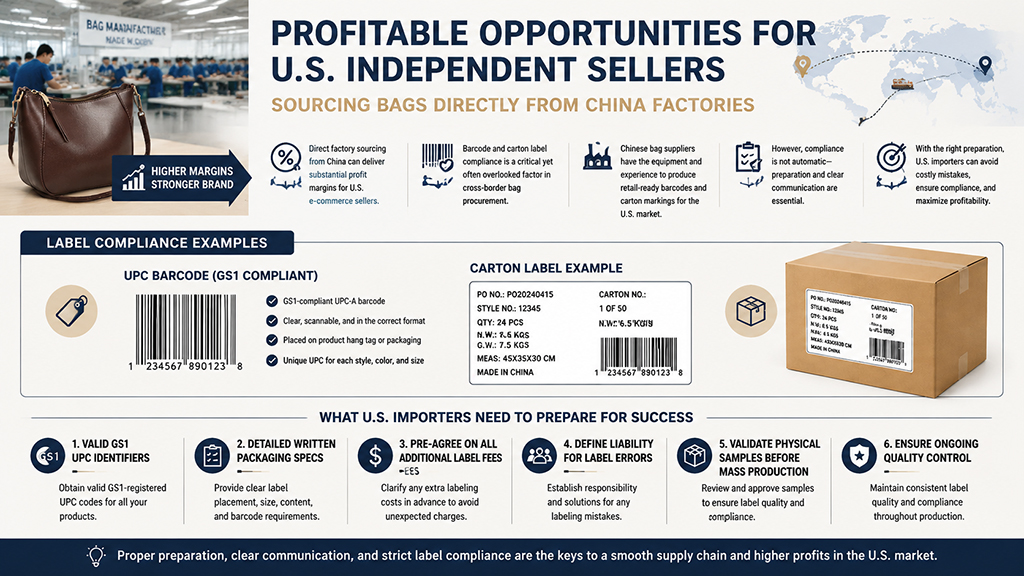
Sourcing bags directly from Chinese factories creates excellent margin opportunities for US independent‑website sellers. Barcode and carton‑label compliance represents a high‑impact, frequently underestimated part of cross‑border bag sourcing.
Chinese bag suppliers possess the equipment and operational experience to produce retail‑ready barcodes and carton markings for the United States market. This output will not happen automatically. Successful outcomes depend on US importers owning valid GS1‑registered UPC identifiers, creating thorough written packaging specifications, clarifying all incremental labelling fees upfront, agreeing clear liability for label‑related errors, and validating physical samples before mass‑production release.
Your exact labeling burden shifts based on your sales channels. Operating purely on your own independent website has simpler labelling requirements. Adding Amazon FBA introduces FNSKU and inbound‑box‑label complexity. Supplying Walmart or Target imposes demanding big‑box distribution‑centre labelling protocols. If you share your full sales‑channel mix, you can further streamline your spec sheet to meet mandatory rules while keeping labelling‑related production costs under control.
Post time: Aug-06-2026