
UV‑Resistant Bag Materials From Chinese Factories: A Complete B2B Buyer’s Guide
What UV‑Resistant Materials Do Chinese Bag Factories Commonly Offer for Outdoor Use?
Chinese bag manufacturers carry a mature lineup of UV‑protective textiles and finishing options built specifically for sun‑exposed applications. Each material has unique strengths, cost ranges and ideal use cases, and choosing the wrong fabric leads to costly post‑sale complaints and product returns.
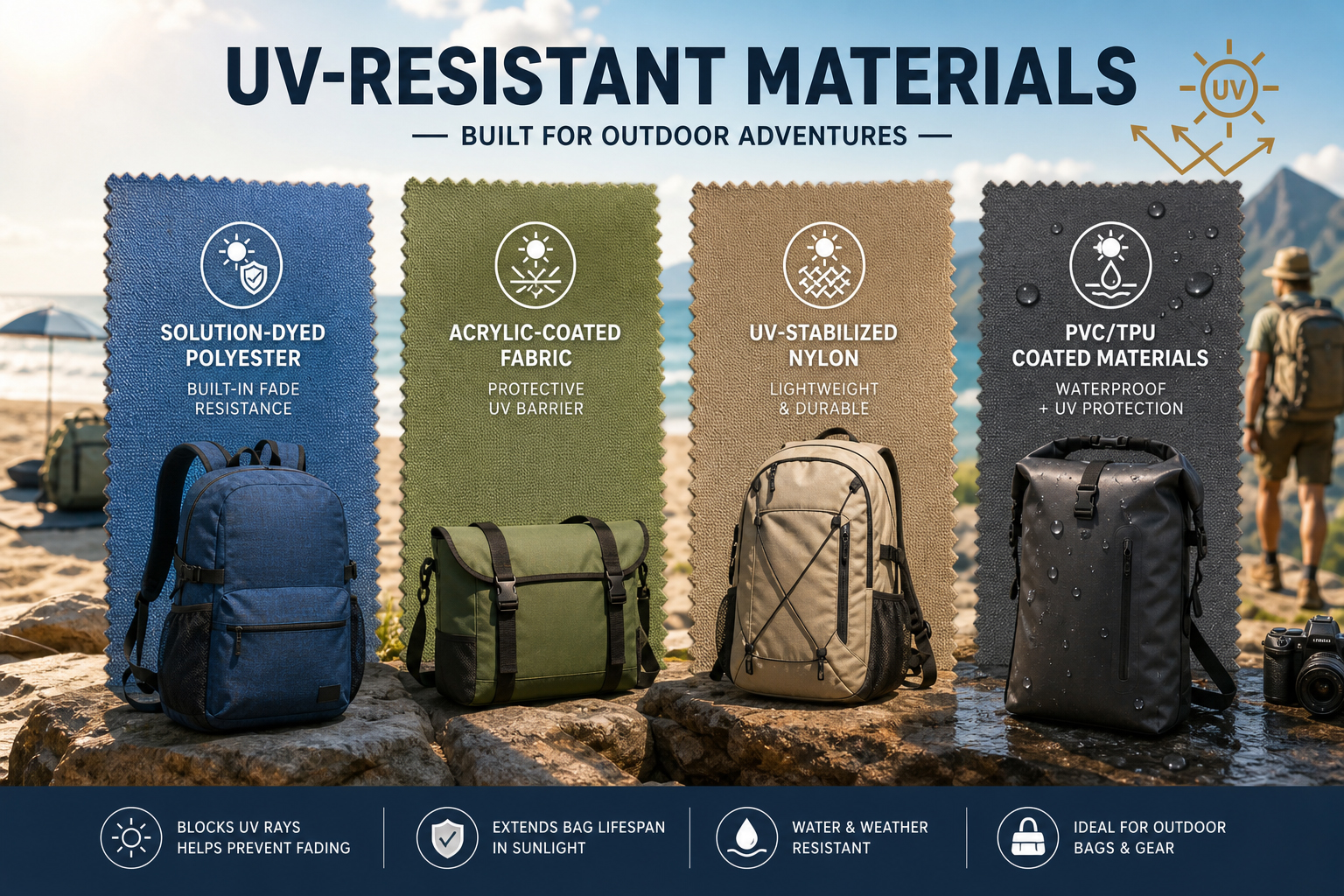
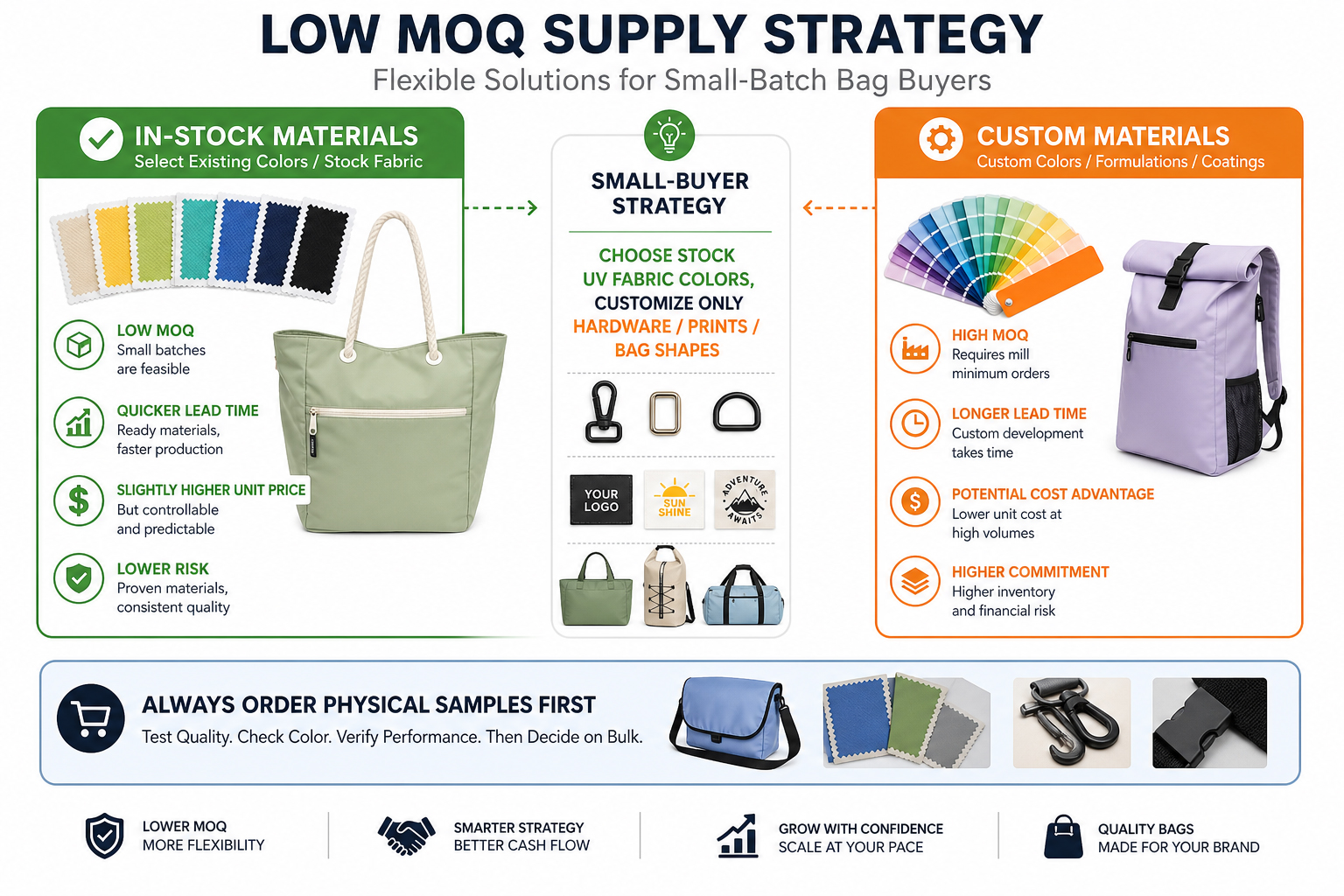
Solution‑dyed polyester fabric ranks as the most widely supplied option. Unlike conventional piece‑dyed textiles that add color after yarn formation, solution‑dyed polyester mixes pigment into melted polymer before fibers are extruded. Color locks deep inside the fiber structure instead of sitting only on the fabric surface. This inherent design delivers outstanding fade resistance under long‑term sun exposure. It is a staple choice for travel backpacks, garden totes and everyday outdoor bags, and most mid‑range Chinese factories keep multiple weights and colors in stock.
Acrylic‑coated fabrics are another popular UV‑protective solution. Factories apply a specialized acrylic surface coating during textile finishing. The coating forms a protective barrier against ultraviolet rays, making the fabric suitable for beach bags, picnic totes and seasonal outdoor accessories. Compared with basic polyester, acrylic coatings improve weather resistance, though buyers should confirm coating thickness and quality consistency across production batches.
UV‑stabilized nylon, usually 600D or 1000D specification, is standard inventory at many Chinese bag plants. Nylon delivers high tensile strength and lightweight performance, which explains its popularity for hiking backpacks and travel luggage. It is critical to note that raw nylon without UV stabilizers fades rapidly and loses mechanical strength outdoors. Reputable suppliers blend UV inhibitors into nylon yarn to slow photodegradation. For high‑use outdoor bags, always specify stabilized nylon rather than generic nylon fabric.
PVC and TPU‑coated materials with added UV inhibitors serve waterproof outdoor bag projects. These coated fabrics combine water resistance and sun protection, frequently used for dry bags, boating gear and wet‑dry travel totes. However, all US buyers need to watch one major defect risk: low‑grade PVC or TPU layers turn sticky, crack or delaminate after repeated UV exposure. The coating quality varies wildly between factories, so material testing becomes non‑negotiable for coated fabric orders.
Several premium Chinese suppliers also provide leather alternatives with UV‑blocking surface treatments for high‑end outdoor bag segments. Synthetic leather without finishing breaks down and discolors quickly in sunlight, but specially formulated surface treatments slow aging and fading. This category targets luxury outdoor shoulder bags and designer‑style travel accessories and sits at a higher price tier.
Beyond main fabrics, professional factories extend UV protection to small yet vital bag components. Some manufacturers use UV‑resistant thread and webbing. Many importers only inspect the main body fabric and ignore stitching. UV rays degrade regular thread gradually, creating broken seams long before the main fabric fails. Top suppliers also apply UV‑resistant lacquers during final finishing. The clear lacquer forms an extra shield, slowing color loss and surface aging on printed logos and exterior panels.
Not every factory has identical material portfolios. Small workshops may only offer basic UV coatings, while large, export‑oriented manufacturers can customize UV protection grades. Suppliers tailor formulations for markets with intense solar radiation, such as tropical zones or high‑altitude regions in North America. Customization allows you to match material performance to your target customer environment instead of settling for one‑size‑fits‑all outdoor fabric.
How Long Do UV‑Resistant Treatments Last on Bags Produced by Chinese Suppliers?
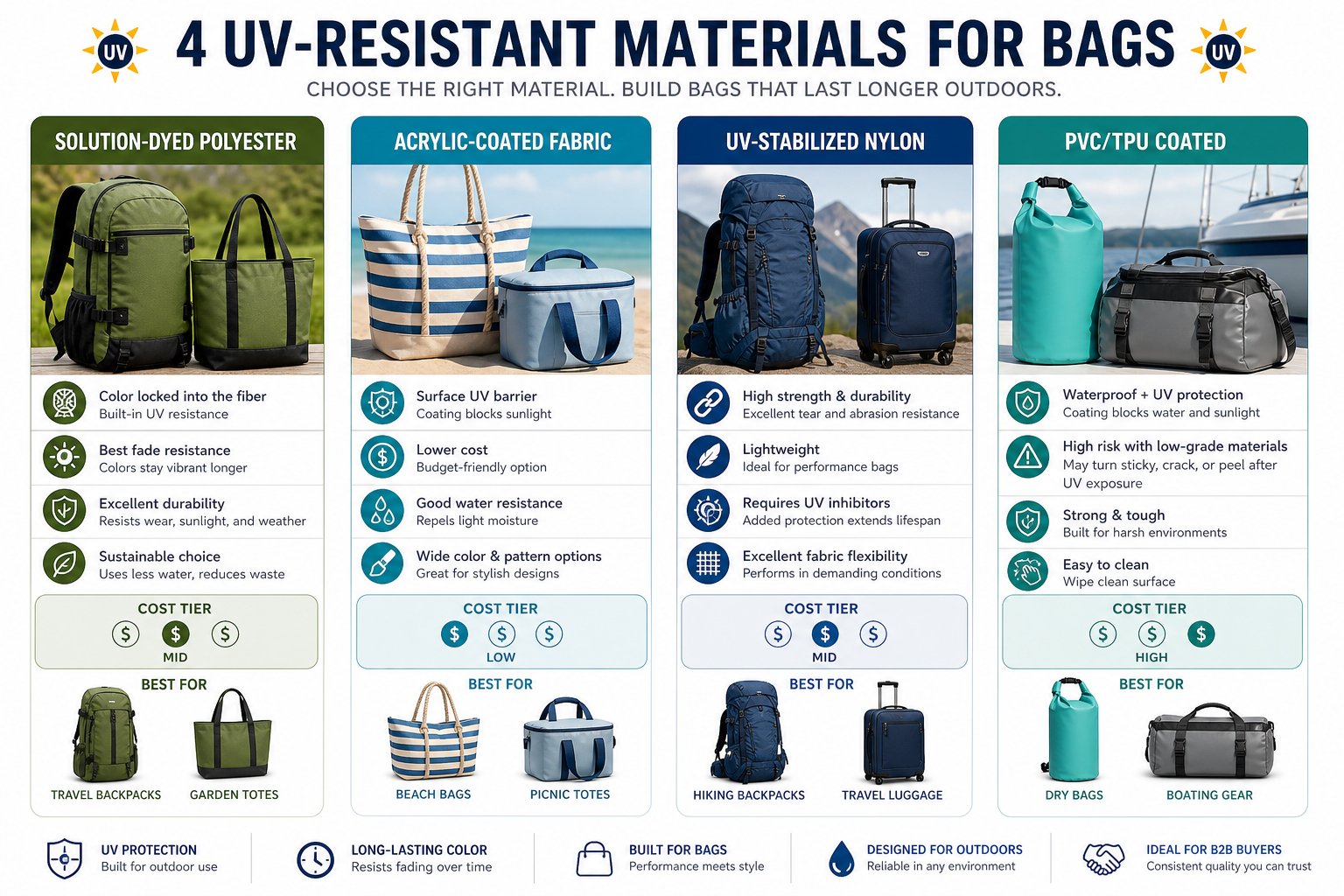
A common misconception among overseas buyers is that “UV‑resistant” equals permanent sun protection. No fabric treatment lasts forever. UV stabilizers and surface coatings gradually wear out with sunlight, heat, rain, friction and regular cleaning. The effective lifespan depends on three key factors: base textile type, stabilizer concentration and coating quality, plus real‑world exposure intensity.
Solution‑dyed polyester has the longest‑lasting color retention, because pigments exist inside fibers instead of a removable outer coating. Its fade resistance does not rely on a surface layer that scratches or washes away. Acrylic lacquers and surface coatings offer temporary protection. Heavy abrasion or frequent washing gradually removes these top layers, and UV performance declines over time. UV‑stabilized nylon maintains good performance for medium‑term outdoor use, yet nylon polymer still slowly degrades under extreme, year‑round strong sunlight.
Chinese factories rely on accelerated weathering QUV testing to predict real‑world aging. QUV machines cycle simulated ultraviolet light, heat and moisture to replicate months or years of outdoor conditions within weeks. Test reports list exposure hours and post‑test conditions, including color change, cracking, peeling, coating loss and strength reduction.
Important warning: Accelerated test hours cannot translate directly into an exact number of usable outdoor years. A fabric passing 500 hours of ASTM G154 testing does not guarantee five years of perfect outdoor service life. The test proves relative durability, not a fixed product lifespan. You should ask factories to state expected performance under typical daily sunlight and confirm acceptable failure limits in your purchase contract.
Many suppliers will only give vague descriptions such as “long‑lasting anti‑fade effect.” Professional B2B negotiations require measurable standards. Request light fastness grade, aging test conditions and pass‑fail criteria instead of vague durability promises.
Are UV‑Resistant Materials Available in Low MOQ for Small B2B Orders from China?
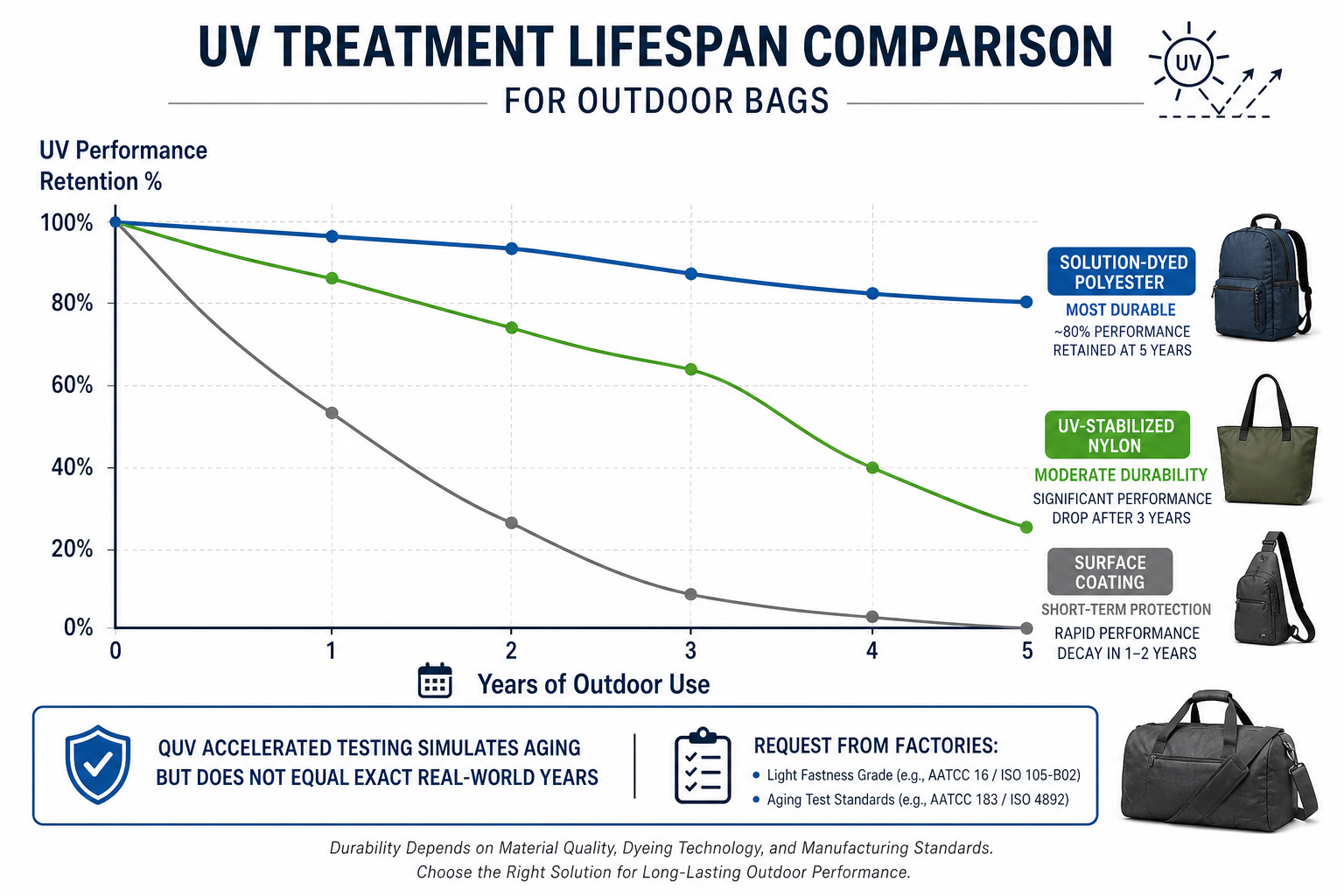
A major worry for small and mid‑sized US independent store owners is minimum order quantity. Many buyers assume high‑performance specialty fabrics only come with huge MOQs. This idea is outdated. The majority of export‑focused Chinese bag factories can supply UV‑resistant materials for small B2B orders, but the pricing and stocking logic varies.
Large factories maintain stock rolls of popular UV‑stabilized textiles, including solution‑dyed polyester and standard UV‑treated 600D nylon. If you select existing colors and in‑stock fabric, MOQ requirements stay low. The factory does not need to run a dedicated dyeing batch, so small orders become economically feasible.
Customization raises MOQ thresholds. When you request custom pigment formulas, unique fabric weights, exclusive coating recipes or custom colors, textile mills require larger minimum rolls. In that scenario, smaller buyers can compromise: pick existing UV fabric colors and modify only hardware, prints or bag shapes to keep low order volumes.
There is a clear price trade‑off. UV‑resistant textiles and upgraded finishing add extra material and processing costs compared with regular untreated fabric. The unit cost rises slightly, especially for premium solution‑dyed acrylic or high‑grade TPU coatings. For small orders, the per‑yard price premium is more noticeable, but the product quality upgrade improves your retail pricing power and reduces customer complaints about fading.
For new product development, always order physical samples first. Request finished bag samples made from your target UV‑resistant fabric before committing to wholesale quantities. Testing samples eliminates expensive mistakes, and most Chinese suppliers offer sample service for small‑batch buyers.
Do Chinese Factories Provide Testing Reports for UV Resistance Performance on Bag Materials?
Yes, qualified export‑oriented Chinese bag factories can provide UV resistance testing reports for bag materials, but not all reports carry equal value. Some suppliers deliver generic certificates from unrelated fabric batches, while serious manufacturers test the exact material and color used for your production. As a professional B2B buyer, you must learn how to evaluate these documents properly.
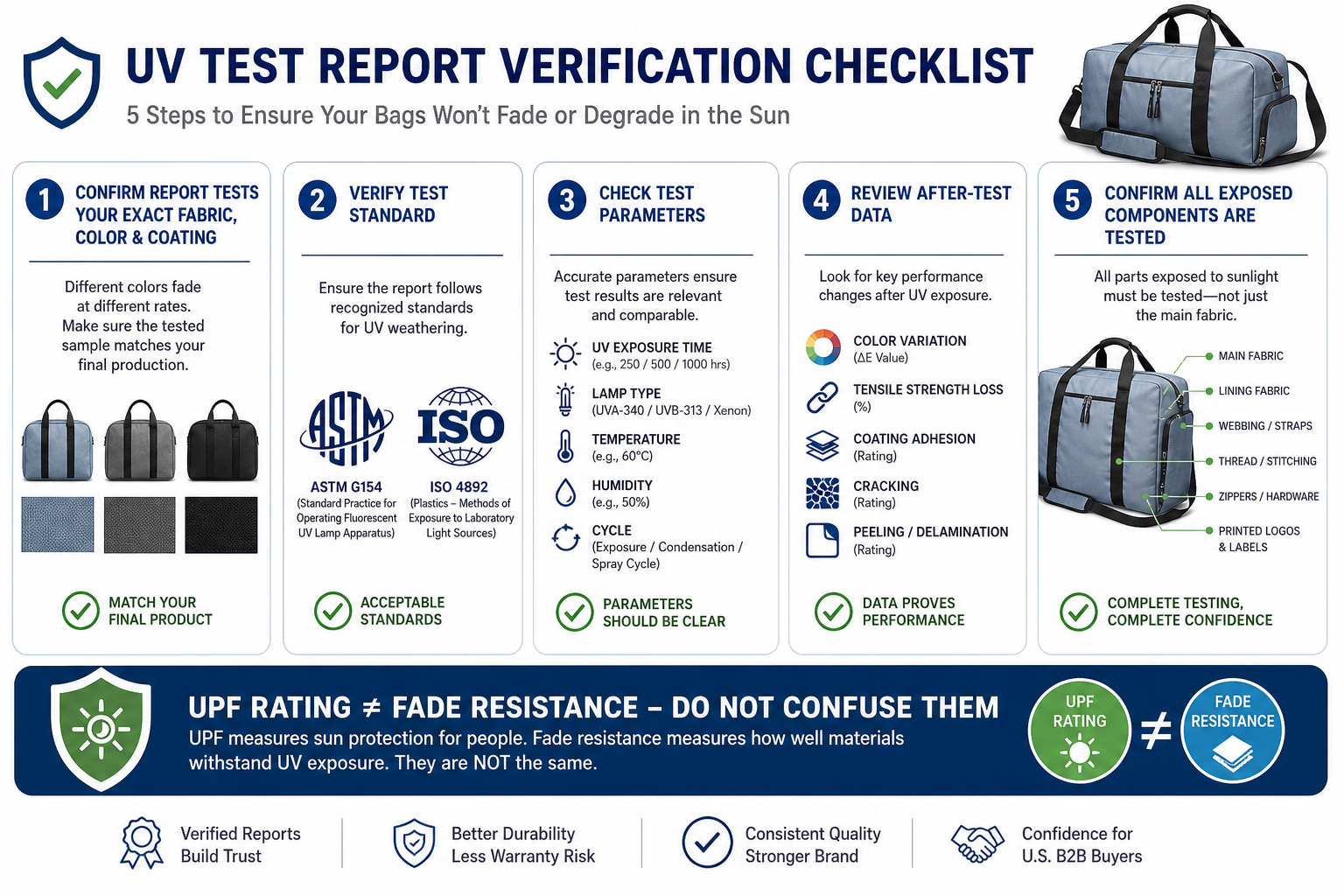
First, clarify the definition of UV resistance. The term covers three separate performance goals: resistance to sun fading, resistance to fabric and coating degradation, and UPF sun protection for human skin. These standards are not interchangeable, and confusion leads to wrong specifications.
For bags, skin protection is rarely your priority. You mainly need two performance benchmarks: colorfastness to light and resistance to weather‑related degradation. UPF ratings measure how much UV radiation penetrates fabric, designed for apparel and sunwear. A UPF 50 rating only blocks UV transmission; it does not guarantee the bag will not fade or turn brittle outdoors. Never substitute UPF certification for light fastness and weathering tests.
When requesting documentation from suppliers, set clear requirements. Ask factories to list the fabric composition and denier, confirm whether yarn is solution‑dyed or mixed with UV stabilizers, and supply a light fastness grade of Grade 4 or higher. Insist on internationally recognized aging standards, ASTM G154 or ISO 4892. ASTM G154 is widely accepted in the US market; it simulates non‑metallic material aging with UV light, heat and moisture and serves as the industry benchmark for outdoor textile evaluation.
A valid report should include full test parameters: total UV exposure time, lamp type, temperature, humidity and repeated exposure cycles. Most importantly, the report must record after‑test data: color variation, tensile and tear strength loss, coating adhesion performance, cracking, peeling and waterproof layer failure.
The biggest red flag is a generic certificate tested on similar fabric instead of your exact fabric, color and coating. Colors affect fading speed drastically. Dark shades, bright hues and fluorescent pigments show fading far more visibly than neutral tones. A report on grey fabric cannot prove the performance of your bright‑colored tote bags. Also, demand testing covering every exposed component: main fabric, lining, webbing, UV thread, zipper tape, printed logos and exterior coatings. A flawless main panel paired with weak stitching still causes product failures.
Independent third‑party testing adds another safety layer for US sellers marketing items as outdoor or UV‑resistant. If your product description highlights anti‑fading and outdoor durability, send finished samples to an American testing lab for verification before launch. This step strengthens credibility with your online customers and avoids false advertising risks.
Practical Sourcing Checklist & Ready‑to‑Send Inquiry Template for Chinese Bag Suppliers
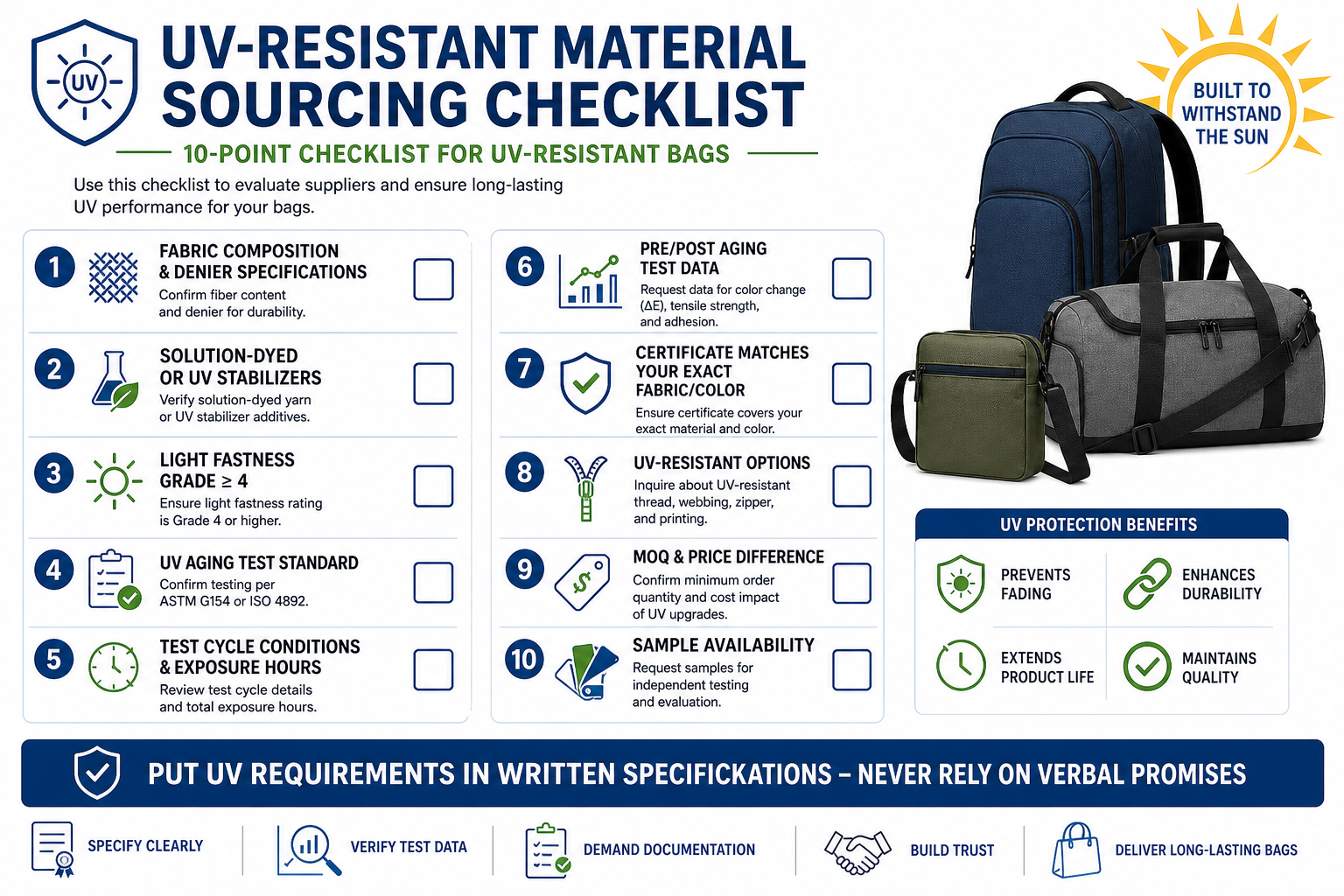
To avoid empty promises and quality disputes, translate all UV requirements into written specifications and attach them to your purchase contract. Do not rely on verbal commitments. Below is the core information you must collect from every potential factory:
Full fabric composition and denier specification
Solution‑dyed yarn or added UV stabilizer details
Light fastness grade (Grade 4 minimum recommendation)
UV aging test standard (ASTM G154 / ISO 4892)
Complete test cycle conditions and total exposure hours
Pre‑aging and post‑aging test results for color change, tensile strength, coating adhesion and waterproof performance
Test certificate matching your selected fabric, color and finished bag construction
UV‑resistant options for stitching, webbing, zippers and printed artwork
MOQ and price difference between standard fabric and upgraded outdoor‑grade UV material
Availability of samples for independent laboratory testing
You can copy and send the following professional inquiry directly to Chinese factories:
Hello, we are an American online retailer sourcing bags for the US market. Our products will be frequently used outdoors under direct sunlight, so reliable UV resistance and anti‑fading performance are critical.
Could you supply UV‑resistant fabric and UV‑protective coatings for bag production? Please share detailed information as listed below:
Fabric composition and denier
Whether the yarn is solution‑dyed or treated with UV stabilizers
Colorfastness‑to‑light rating; Grade 4 or above preferred
UV aging test standard such as ASTM G154 or ISO 4892
UV exposure duration and full test environmental conditions
Before‑and‑after test data on color shift, tensile strength, coating adhesion, cracking, peeling and waterproof performance
Official test report issued for our exact fabric color and finished bag structure
UV‑resistant choices for thread, webbing, zipper tape, printed logos and surface coatings
MOQ and price gap between regular fabric and premium outdoor UV‑resistant material
Can you provide samples suitable for independent third‑party lab testing?
Please quote both standard textile and upgraded outdoor‑grade UV‑resistant options. Also state the expected outdoor service life under regular sunlight. We understand lab test results do not equal a guaranteed exact lifespan for finished bags.
Final Verification Steps Before Large‑Scale Orders
Many B2B buyers only check samples visually and skip long‑term validation. Follow this systematic verification workflow to reduce sourcing risk:
Order samples made with your actual production colors, not neutral demo swatches
Collect fabric data sheets and matching laboratory reports and cross‑check sample details
Confirm reports list factory name, fabric formula, color code, test method, exposure hours and measurable results
Run independent US lab testing if your website markets outdoor UV‑resistant features
Compare untreated control samples side‑by‑side with UV‑treated samples
Test complete assembled bags, including seams, handles, stitching and printed logos, not only loose fabric
Embed clear UV performance standards and failure criteria in contracts and approved sample documentation
Reject vague sales language like “waterproof and UV resistant.” A precise purchasing requirement reads: “Approved fabric must achieve at least Grade 4 colorfastness to light and pass agreed ASTM G154 exposure cycles without unacceptable cracking, peeling, seam breakage or coating failure.” Agree on exposure hours and pass‑fail limits before mass production starts.
Conclusion
Sourcing UV‑resistant bags from Chinese manufacturers is completely viable for US independent website sellers. Factories offer a diverse selection of professional outdoor textiles, accept low‑volume B2B orders for in‑stock UV fabrics and can provide formal UV aging test reports upon request. However, true expertise lies in digging past marketing buzzwords. Successful wholesale purchasing requires you to distinguish different UV‑protection mechanisms, understand test standard limitations, specify measurable performance grades, validate samples and lock technical requirements into contracts. When you implement this structured sourcing strategy, you gain durable, sun‑proof bag inventory that stands out from generic imported goods, builds trust with your American customers and reduces costly returns caused by sunlight damage.
Post time: Sep-07-2026