
Published for US online bag retailers sourcing directly from China
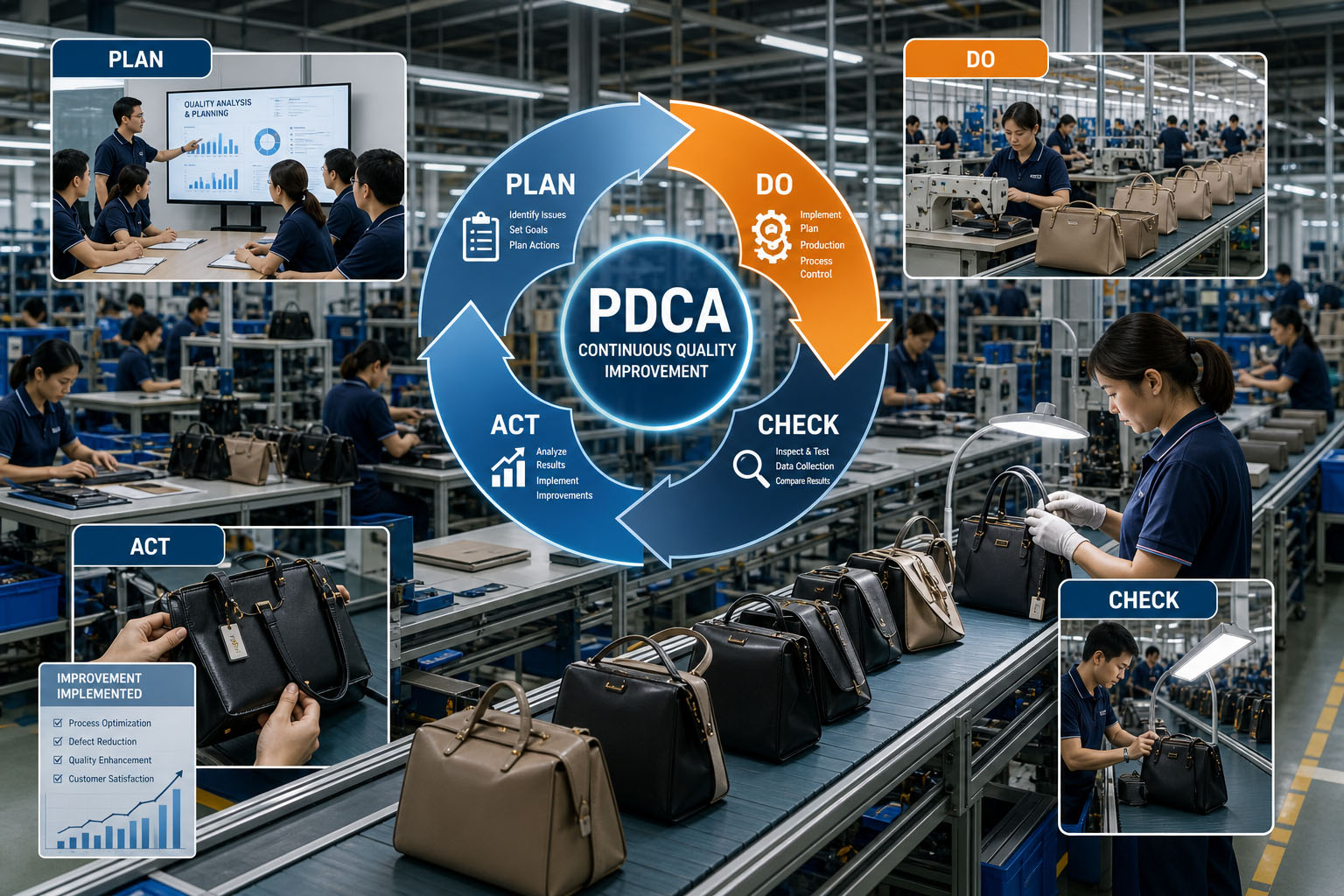
For United States‑based bag e‑commerce merchants, sourcing bags directly from Chinese factories creates massive opportunities for better margins, custom branding, and expanded product lines. However, direct overseas manufacturing comes with well‑documented risks: inconsistent defect rates, inadequate corrective actions, missing third‑party pre‑shipment inspections, non‑compliance with US chemical and safety standards, and intellectual property leaks for custom logos and proprietary bag designs. Too many independent website sellers jump into China sourcing only to receive defective inventory, face costly regulatory penalties, or discover their original bag designs have been copied and resold to competing marketplaces.
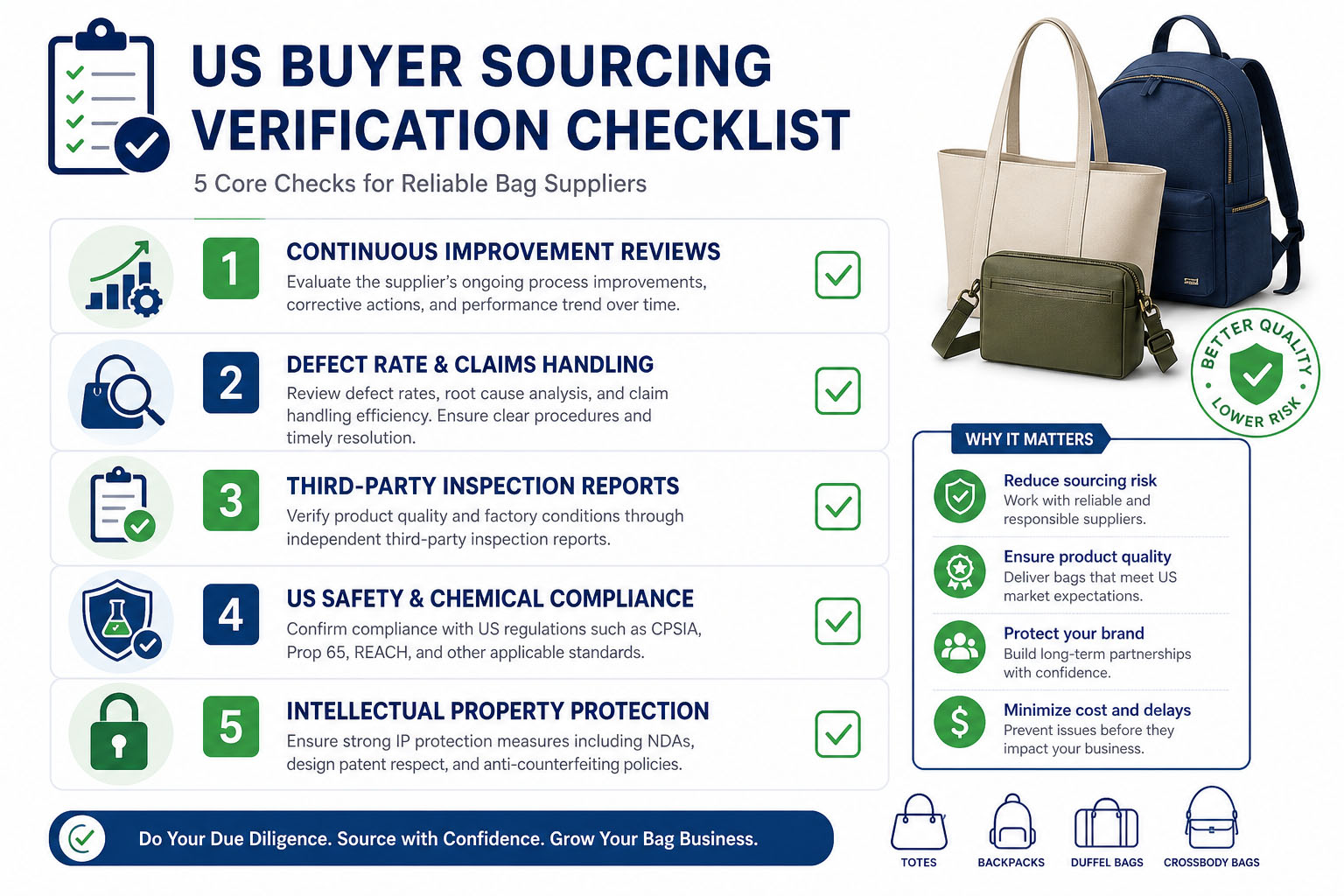
The core foundational question every US bag buyer must ask potential Chinese manufacturing partners is straightforward: **Do you carry out continuous improvement reviews to analyze defects and feedback to refine future production runs?** This single question unlocks visibility into a supplier’s true quality culture, rather than relying on polished sales quotes and sample photos. Alongside this overarching inquiry, four critical follow‑up questions form your supplier qualification checklist:
1. What is your typical defect rate, and how do you handle defective units or replacement claims?
2. Do you provide third‑party inspection reports (e.g., SGS, Intertek, BV) before shipment?
3. Are your products compliant with US safety and chemical regulations such as CPSIA, Prop 65, or REACH?
4. How do you safeguard my proprietary designs, logos, and brand intellectual property during production?
This blog breaks down exactly what these questions mean in real‑world Chinese bag factory operations, explains what genuine continuous improvement looks like, outlines tangible verification steps you can implement, and clarifies compliance and IP protection expectations for US independent website sellers. Whether you source backpacks, fashion handbags, cooler lunch bags, travel duffels, or crossbody bags, this framework will help you filter qualified manufacturers and embed quality protections into your purchase agreements.
Understanding Continuous Improvement Reviews in Chinese Export‑Oriented Bag Factories
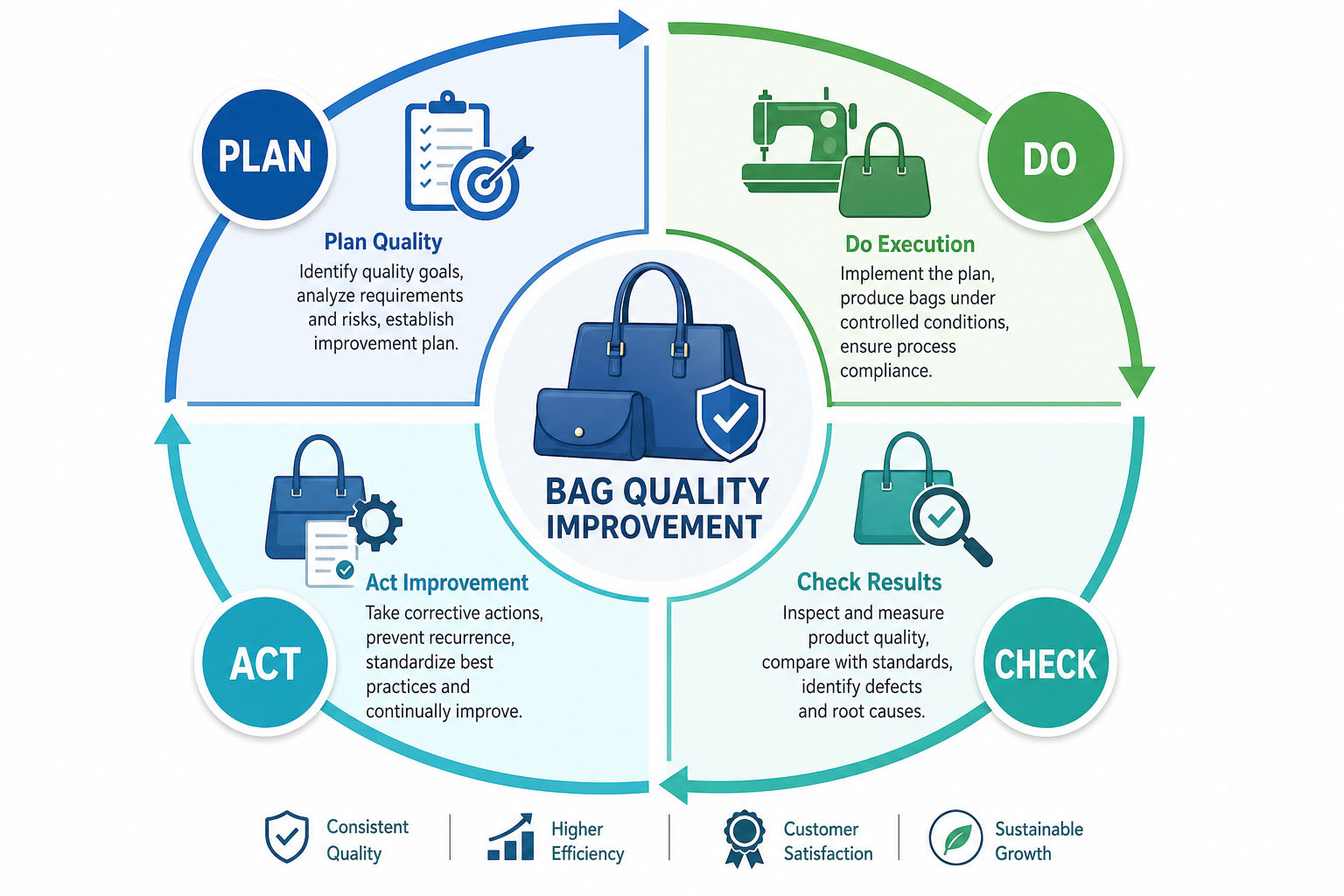
Continuous improvement reviews are a documented requirement under ISO 9001:2015, and most export‑focused Chinese bag factories maintain this certification. ISO 9001 is not merely a paper certificate; it mandates formal management reviews, corrective action workflows, and systematic learning from past production mistakes. Still, holding the certificate does not automatically guarantee flawless execution on the factory floor. As a US buyer, you must validate whether documented systems are actively practiced, not just printed in a manual.
Nearly all professional export bag factories utilize the PDCA (Plan‑Do‑Check‑Act) cycle as their core standard framework to analyze defects and refine subsequent production runs. This four‑step loop guides teams through setting quality standards for new bag styles, executing mass production, checking finished goods against specifications, and rolling out process adjustments when quality gaps emerge.
Customer complaints and feedback reports are logged into centralized quality databases and reviewed during recurring quality meetings. When defects repeat across batches, quality teams deploy established root‑cause analysis tools. The 5‑Why method and Fishbone (Ishikawa) diagrams are widely applied to dig past surface‑level failures and uncover underlying sources of trouble: poor raw material quality, unclear sewing work instructions, operator training gaps, defective hardware, or misinterpreted design specifications.
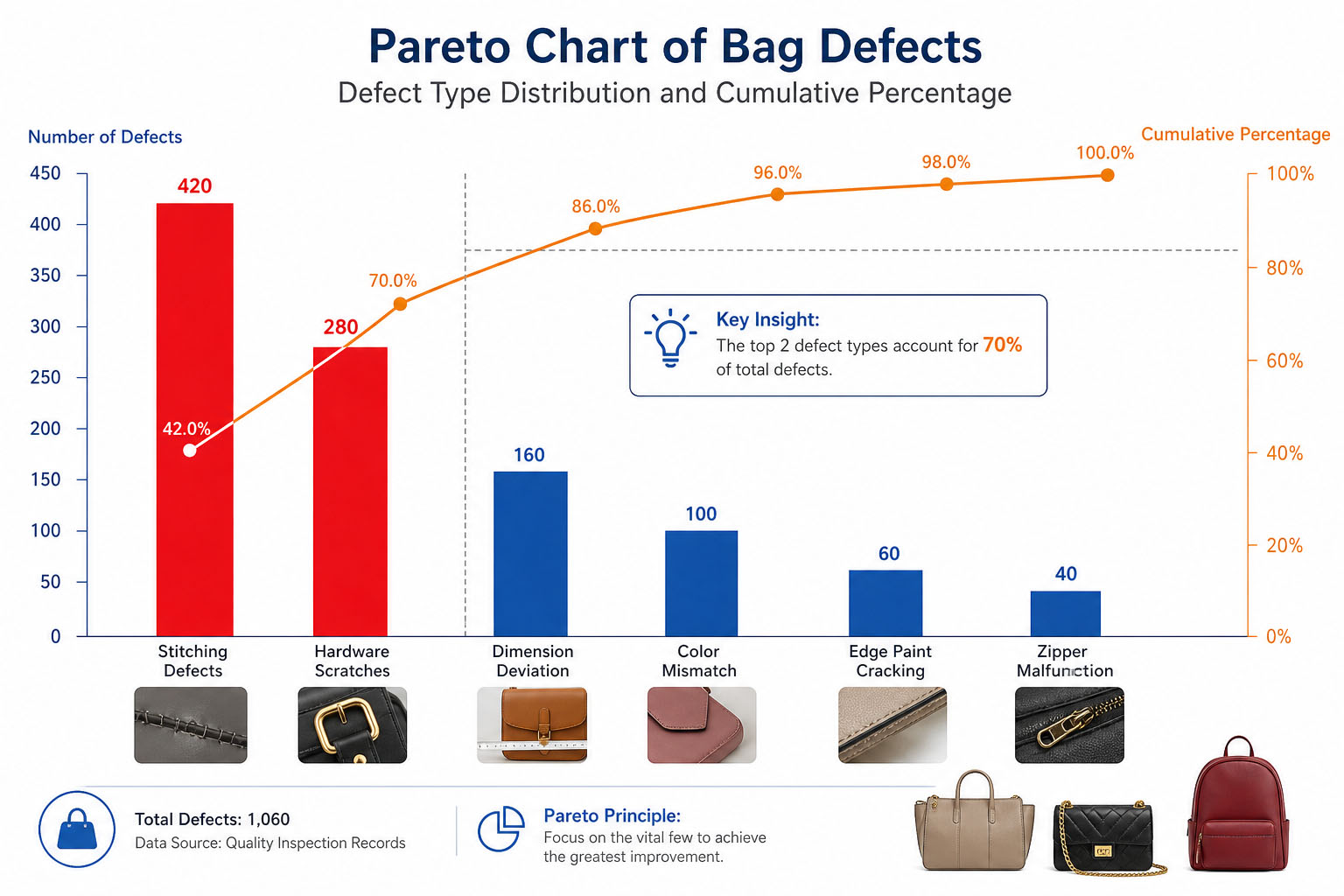
Defect data is frequently visualized through Pareto charts. These charts allow factory management to prioritize the highest‑frequency, highest‑impact quality issues so corrective resources focus on problems that create the most customer complaints and product returns. Third‑party inspection results from agencies such as SGS, Bureau Veritas, and TÜV are routinely fed back into the supplier’s internal review process. Failures flagged during pre‑shipment inspections become input for internal quality meetings alongside in‑line QC data and end‑customer return feedback.
Many factories run Kaizen‑style small‑group improvement activities. These sessions engage front‑line line workers, not only office managers, in identifying and solving production issues directly on the shop floor. Sewers, material cutters, and assembly staff often spot practical production pain points that office‑based engineers overlook.
Modern manufacturers are shifting away from paper‑based tracking. Digital Quality Management System (QMS) platforms are increasingly replacing paper records, enabling real‑time defect tracking and trend analysis across separate production batches. This digital visibility makes it far easier to spot creeping quality degradation as production volumes ramp up.
A formal CAPA (Corrective and Preventive Action) system is the backbone of structured improvement. CAPA addresses both immediate defects found in current orders and preventive steps to stop identical issues from appearing in future production runs. Continuous improvement performance metrics are often compiled into supplier scorecards shared with international buyers. These scorecard results directly influence future order allocation for large‑volume overseas customers.
It is critical for US independent‑site sellers to understand: many reputable Chinese bag manufacturers do perform continuous improvement reviews, but this quality discipline is never automatic. You must verify these workflows during supplier qualification and write corresponding requirements into your formal contract terms. A supplier saying “yes, we do continuous improvement” means almost nothing without supporting evidence.
What Real‑World Continuous Improvement Looks Like Inside Bag Factories

In practical day‑to‑day factory operations, manufacturers serious about quality follow a repeatable workflow. First, they collect defect data from multiple independent sources: in‑line QC checks performed while bags are being assembled, final finished‑goods inspections after production completes, and incoming customer complaints and product returns from overseas buyers. Data from all these streams feeds into the quality review cycle.
Factories hold regular quality meetings, typically weekly or monthly. During these meetings, teams review defect rates broken down by bag style, production line, and individual production batch. Participants identify root causes, sorting problems into material failures, workmanship errors, design flaws, or process gaps. The group agrees on concrete Corrective and Preventive Actions (CAPA) to resolve discovered issues.
After defining corrective actions, teams update official production documentation. Revised work instructions for sewing operators, updated QC checklists for inspectors, and adjustments to approved sample standards all translate abstract feedback into actionable shop‑floor rules. Improvements are tracked over time using measurable key performance indicators: overall defect rate in percentage or PPM, first‑pass yield percentage, rework rate for defective bags, and customer return and complaint rate.
Factories holding valid ISO 9001 certification are formally obligated to operate corrective/preventive action processes and periodic management reviews. This is exactly the structured continuous improvement system US buyers want to see. Keep in mind, however, that certificates can be falsified or scoped for unrelated product categories, so always cross‑check certificate scope and expiration date.
How to Verify Whether Your Specific Bag Supplier Actually Implements These Processes
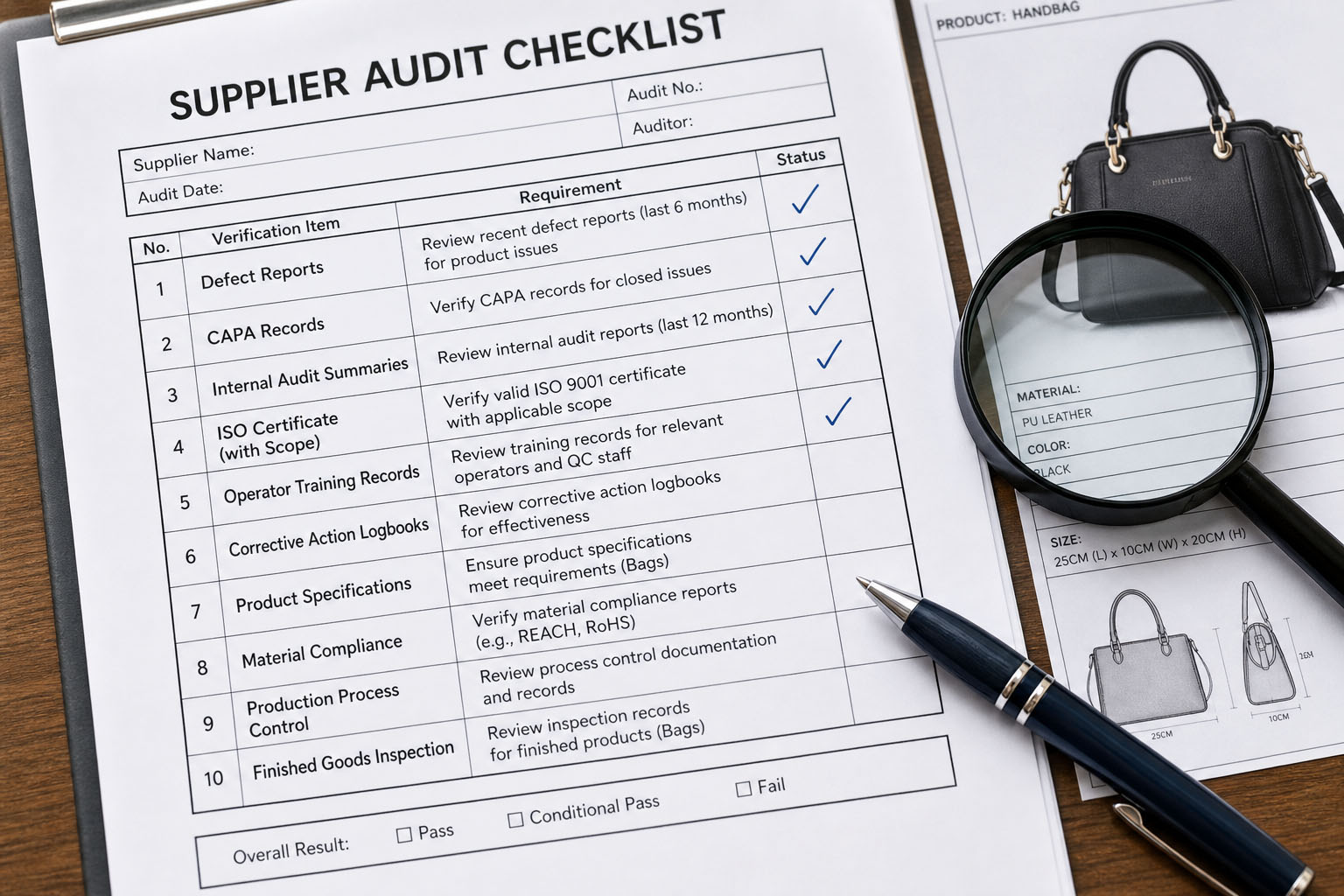
When you pose your continuous‑improvement question to Chinese bag suppliers, push for tangible proof instead of simple affirmative answers. Use direct probing questions during email communication, video calls, and factory visits.
Use these targeted questions in your supplier outreach:
- “Can you share defect reports covering the last 3‑6 months, and explain specifically how these reports drove changes in production?”
- “What is your full workflow when a customer reports product defects? Which team reviews the feedback, and how are findings communicated back to the production floor?”
- “Do you hold recurring quality review meetings? What is the frequency, and which departments attend these sessions?”
- “Can you provide examples of updated work instructions or QC checklists modified in response to past production defects?”
Request supporting documentation from your potential partner. Accept redacted versions that remove other client confidential data: defect rate reports sorted by order or product style, completed CAPA records, internal audit reports or management review meeting minutes, and a full ISO 9001 certificate with its defined product scope.
Conducting a formal factory audit is one of the most reliable validation steps for high‑volume bag sourcing. During on‑site audits, inspectors will review QC checkpoints, operator work instructions, and staff training records. Auditors examine historical defect‑rate reports, first‑pass yield charts, and corrective action logbooks. They also verify physical procedures for segregating non‑conforming defective products so flawed bags do not accidentally get packed into customer shipments.
If your contact cannot produce supporting records and only offers vague, general replies, treat this as a major red flag. Their “continuous improvement” system exists only on marketing materials, not on the production floor.
Embed Continuous Improvement Requirements Into Your Sourcing Workflow
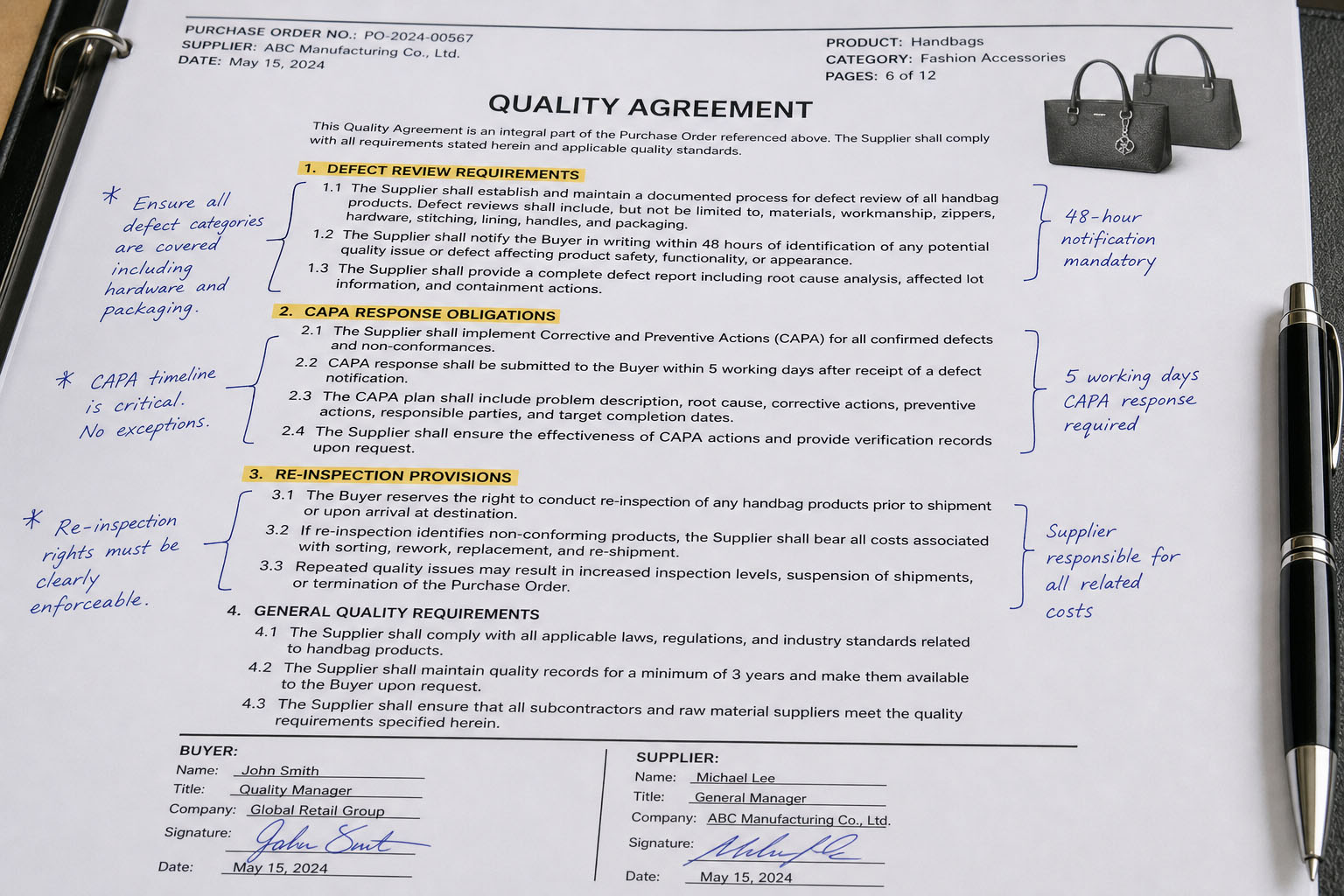
Verifying past performance is only half the battle. You need contractual safeguards to ensure your own defect feedback shapes future production batches for your brand. Four practical steps reduce quality risk for US independent website sellers.
First, write explicit expectations into your formal contract or dedicated quality agreement. Require periodic defect and complaint review sessions with your supplier. Mandate written CAPA responses whenever major quality defects occur within your orders. Demand revised QC documents whenever recurring product issues are identified. These clauses give you contractual leverage if quality declines in repeat orders.
Second, require pre‑shipment production samples from every mass‑production run. Compare new production samples against your approved golden sample and your written specifications. These samples confirm that process improvements promised by the factory have actually been implemented. Many sellers make the mistake of approving one pre‑production sample and skipping sample checks for subsequent re‑orders, opening the door for quality drift.
Third, leverage third‑party inspections across different production phases: pre‑production inspection before materials are cut, in‑process inspection mid‑run, and final inspection before goods leave China. Forward full inspection reports to your factory contact and require a formal written response outlining remedial actions for every non‑conformity noted.
Fourth, start with smaller trial orders before scaling to large bulk orders. Use initial trial production to stress‑test your supplier’s quality feedback and improvement process. If they fail to resolve small‑scale issues on trial runs, problems will compound when you place high‑volume orders for your e‑commerce store inventory.
You can copy‑paste this ready‑to‑use inquiry template to send directly to prospective Chinese bag manufacturers:
> “Do you carry out continuous improvement reviews that analyze defects and customer feedback to refine future production runs?
> If yes, please share:
> – Your standard process for reviewing defects and feedback
> – Examples of changes you made to production or QC based on past issues
> – Any relevant certifications (e.g., ISO 9001) and recent internal audit or quality review summaries (confidential information can be redacted).”
Three Additional Non‑Negotiable Topics for US Bag E‑Commerce Buyers
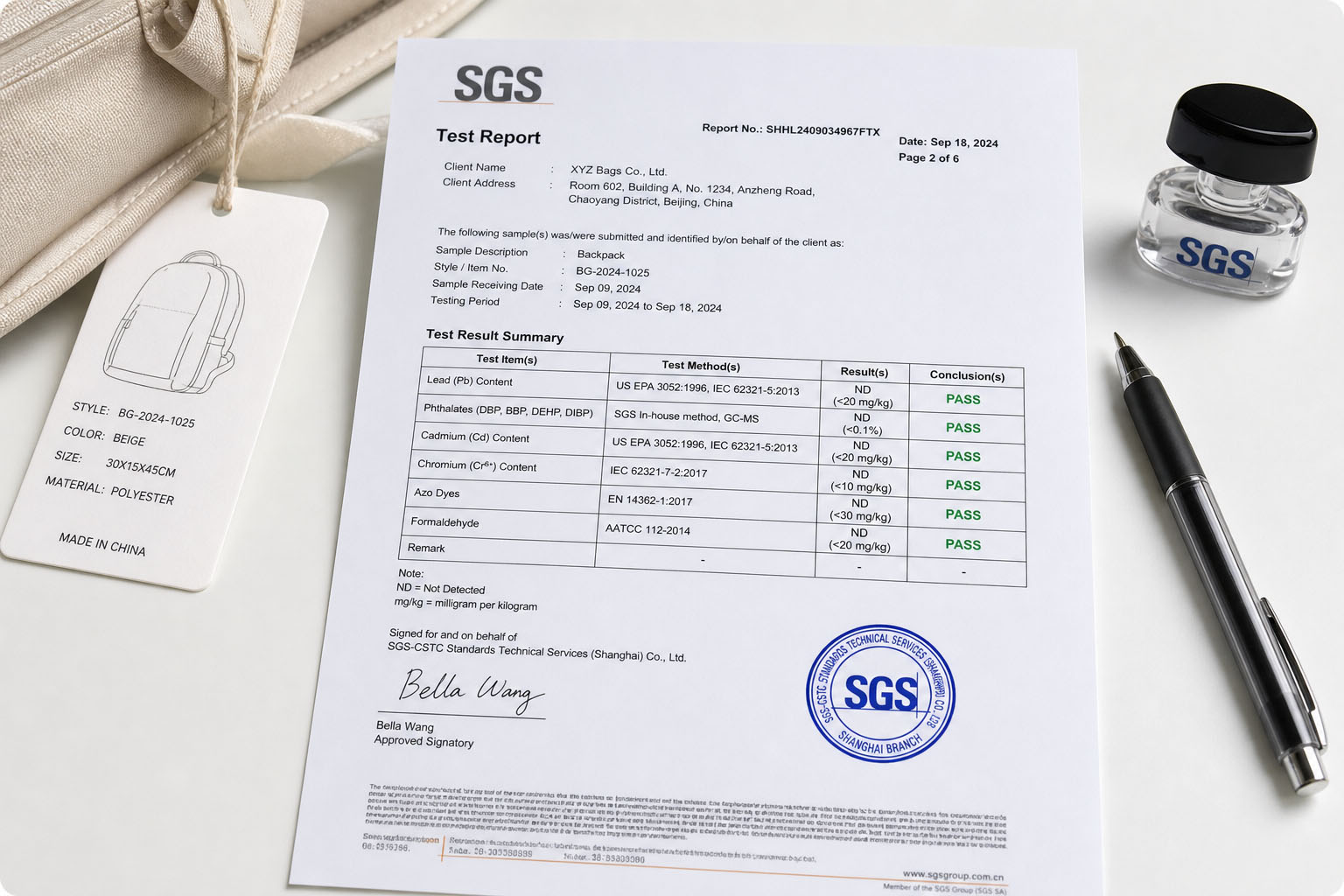
Continuous improvement processes set the foundation for stable quality, but US sellers must resolve three further critical topics before confirming orders: third‑party pre‑shipment testing, United States regulatory compliance, and intellectual property protection for your custom branded bags.
Third‑party pre‑shipment inspection reports
Reputable Chinese bag suppliers are able to provide third‑party inspection reports from globally recognized labs including SGS, Intertek, and BV before shipment. Independent third‑party inspectors audit finished goods against your specifications, checking workmanship, dimensions, hardware function, printing quality, packaging, and overall defect rates. Do not rely entirely on factory self‑inspection reports. Internal QC reports carry bias, while neutral third‑party reports offer objective evidence you can reference when resolving shipping or quality disputes. Schedule final inspections when 100% of production is finished and goods are fully packed for container loading.
US safety and chemical regulatory compliance
Your imported bags sold to American consumers must satisfy US safety and chemical regulations including CPSIA, California Proposition 65, and REACH requirements. Non‑compliant inventory can trigger customs holds, product recalls, heavy fines, and brand‑reputation damage for your US‑based website business. Confirm your factory performs corresponding laboratory testing for lead content, phthalates, heavy metals, and restricted chemical substances present in fabrics, zippers, plastic hardware, printing inks, and faux‑leather materials. Request valid test reports matching your exact item SKUs. Avoid generic lab reports referencing unrelated bag styles.
Intellectual property protection for custom designs, logos and branding
When you develop proprietary bag shapes, custom artwork, and exclusive brand logos, IP leakage is a substantial risk in China sourcing. Reliable bag factories will sign and strictly honor NNN (Non‑Disclosure, Non‑Use, Non‑Circumvention) agreements. This legal contract prohibits the manufacturer from disclosing your designs to third parties, producing your branded goods for competing sellers, or selling your proprietary‑style bags under other brand names. Confirm exactly which factory personnel will access your confidential design files. Ask what internal controls prevent design leaks, such as restricted‑access digital file storage and limits on sample distribution. Never send custom design files to suppliers before your NNN agreement is fully executed.
Final Takeaways for US Independent Website Bag Sellers
Sourcing bags directly from Chinese factories delivers excellent profit potential for your US e‑commerce website, yet success depends far more on supplier process discipline than low unit prices. Continuous improvement reviews are not a theoretical quality buzzword; they represent the system that stops the same manufacturing defects from repeating across your successive orders.
Treat your four core questions as your baseline supplier‑qualification toolkit. Always ask for tangible documentation, audit evidence, and real‑world case examples instead of accepting simple yes‑or‑no answers. Put quality, compliance, and IP terms into your written contracts. Utilize third‑party inspections and testing to verify compliance with CPSIA, Prop 65 and REACH. Secure NNN agreements before sharing any proprietary designs or brand assets. Start with trial‑sized orders to validate performance before committing to large‑volume production.
Many US bag sellers fixate only on unit cost and sample appearance. The most resilient e‑commerce brands invest time vetting the underlying factory systems that protect your brand reputation after mass production begins.
Post time: Aug-12-2026